
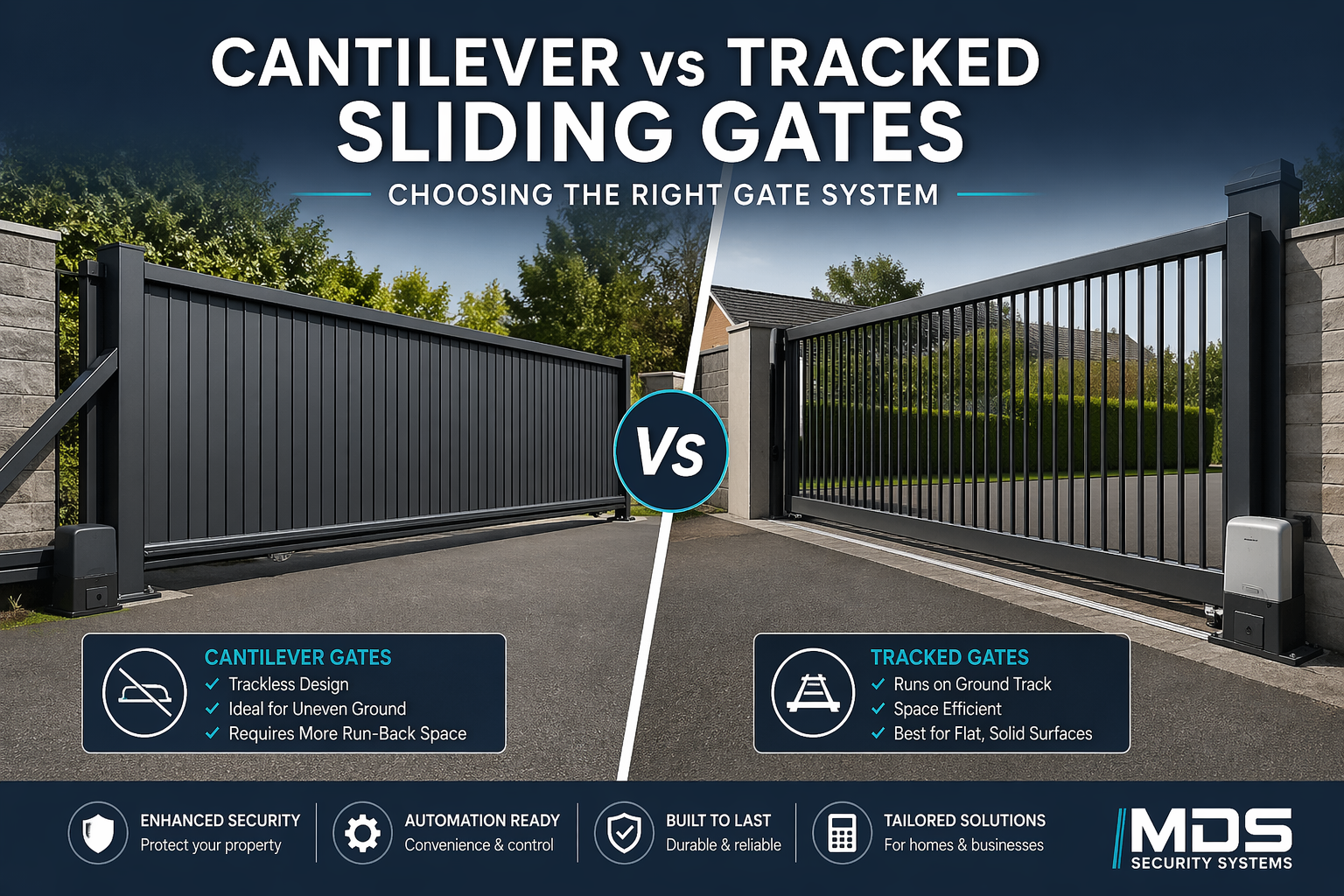
Cantilever vs Tracked Sliding Gates: Choosing the Right Gate System
Choosing the ideal gate system for your property is an important decision that affects daily vehicle access, security, safety and long-term reliability. When comparing cantilever vs tracked sliding gates, property owners need to consider site conditions, available space, ground levels, security requirements and how often the gate will be used.
Both systems can offer excellent performance when installed correctly. Cantilever gates use a trackless design and counterbalance system, making them ideal for uneven ground, gravel driveways and sites where debris may be an issue. Tracked sliding gates, on the other hand, run along a fixed ground track, making them a highly space-efficient option for properties with flat, solid surfaces.
If you are considering sliding gates for your property, this guide explains the key differences, advantages and considerations to help you choose the right system.
Cantilever Sliding Gates: Overview
Cantilever sliding gates operate without a ground track running across the driveway entrance. Instead, the gate is supported by a heavy-duty counterbalance system and guide rollers mounted behind the fence line. This allows the gate to glide above the ground rather than rolling directly on the surface.
Because cantilever gates hover above the driveway, they are particularly suitable for uneven ground, sloped entrances, gravel drives, industrial sites and areas where leaves, dirt or ice could cause issues for a traditional ground track.
The main consideration with cantilever gates is space. Due to the counterbalance section, they usually require around 40% to 50% extra run-back space along the fence line compared with the actual opening width.
Tracked Sliding Gates With Ground Track
Tracked sliding gates operate by rolling horizontally along a fixed metal ground track set into the driveway surface. This type of gate system provides excellent stability and is highly space efficient because the gate only needs enough room to clear the opening itself.
Tracked systems are often a good choice for residential properties, commercial premises and sites with limited side space, provided the ground is flat, solid and suitable for installation. Concrete and tarmac surfaces are usually best for this type of gate.
However, tracked sliding gates do require regular track cleaning. Leaves, stones, dirt, snow and debris can collect in the ground track, which may affect smooth operation if not cleared regularly.
How Each Gate System Operates
The way each gate moves is one of the biggest differences between the two systems. Tracked sliding gates use wheels attached to the bottom of the gate. These wheels roll directly along the ground track, supporting the gate’s weight as it opens and closes.
This direct ground contact gives tracked gates excellent strength and stability, especially across wide openings. However, because the wheels are in contact with the track, they can be more affected by debris, ice and surface wear.
Cantilever sliding gates use rollers housed within the gate structure and support posts. The gate does not touch the ground, which often results in smoother and quieter operation. This also reduces the risk of problems caused by ground-level debris or uneven surfaces.
Site Suitability, Space and Layout
Before choosing between cantilever and tracked sliding gates, your site layout should be assessed carefully. Tracked sliding gates are best suited to properties with flat, stable ground and limited side space. To calculate the required run length, you generally need the width of the driveway opening plus a small allowance for the motor and end stops.
Cantilever gates are usually better for uneven ground, gravel surfaces, industrial sites, high-traffic areas and locations where a ground track would be impractical. To calculate the required side clearance for a cantilever gate, take the opening width and add around 40% to 50% extra space.
For example, a 6-metre opening may require approximately 9 metres of total run-back space along the fence line for a cantilever system.
Automation: Electric Sliding Gates and Controls
Both cantilever and tracked systems can be automated, making them suitable for secure and convenient electric gate access. Automated sliding gates use electric motors designed to handle the size, weight and frequency of use required for the property.
These systems can also be integrated with access control options such as keypads, intercoms, remote controls, fobs and smartphone entry systems. For larger commercial sites, they can also be connected with wider security systems.
If you are looking for automated entry solutions, MDS Security Systems provides a range of automatic gates for domestic, commercial and industrial properties.
Security Considerations and High Security Use
Both cantilever and tracked sliding gates can provide strong physical protection against unauthorised access. Sliding gates are difficult to force open because of their lateral movement, weight and secure closing position.
Tracked sliding gates can offer excellent resistance because they are firmly supported by the ground track. Cantilever gates are also highly secure, especially when built using strong materials and combined with high-quality locking systems.
For higher security sites, gates can be strengthened with magnetic locks, mechanical deadbolts, access control, intercoms, CCTV and ANPR systems. MDS Security Systems also supplies CCTV systems and wider fences and perimeter protection for properties requiring a more complete security solution.
Installation Steps and Practical Planning
Correct installation is essential for safety, reliability and long-term performance. For cantilever sliding gates, the main foundation requirement is a substantial concrete base positioned to one side of the opening. This supports the posts, rollers and weight of the gate.
Tracked sliding gates require ground preparation across the full driveway opening. The ground track must be installed level and securely fixed into a suitable foundation. If the track is not level, the gate may become noisy, unreliable or put unnecessary strain on the motor.
Before installation, a professional survey should assess ground levels, drainage, available space, power supply, safety requirements and the type of access control needed.
Maintenance, Servicing and Longevity
Regular maintenance helps keep sliding gates safe, reliable and efficient. For tracked sliding gates, the most important task is keeping the ground track clear of stones, dirt, leaves, ice and other debris. The wheels, motor housing and track should also be inspected regularly for wear.
Cantilever sliding gates usually require less day-to-day cleaning because there is no ground track. However, guide rollers, support posts, motors, safety edges and moving components should still be checked and maintained.
For all automated gate systems, professional servicing is recommended every six to twelve months, depending on usage. MDS Security Systems provides electric gate repairs, maintenance and servicing to help keep systems operating safely and correctly.
Costs, Sizing Limits and Material Choices
The cost of a sliding gate system depends on several factors, including the size of the opening, gate weight, material choice, automation requirements, access control options and groundworks.
Tracked sliding gates can sometimes be more cost-effective to manufacture, but the installation cost may increase if extensive ground preparation is required. They can be suitable for very wide openings when installed on the right surface.
Cantilever gates are often more expensive because they require additional structural support and a counterbalance section. However, they are extremely practical for sites where a ground track would be unsuitable.
Common material choices include galvanised steel and powder-coated aluminium. These materials offer durability, strength and resistance to weathering when properly finished and maintained.
Safety Standards, Compliance and Best Practice
Safety is one of the most important parts of any powered gate installation. In the UK, automated gates must be designed and installed to reduce the risk of crushing, trapping or impact hazards.
Electric sliding gates should include suitable safety features such as photocells, obstacle detection, rubber safety edges and safe force limitation. These features help stop or reverse the gate if a vehicle, pedestrian or object is detected in the gate’s path.
Businesses and commercial property owners should also keep accurate servicing and inspection records. This helps demonstrate that the gate system is being maintained safely and responsibly.
Decision Checklist for Buyers
Use this checklist when deciding between cantilever and tracked sliding gates:
- Choose cantilever gates if your site has uneven ground, gravel, slopes, debris, heavy use or poor drainage.
- Choose tracked sliding gates if your site has flat, solid ground and limited side space.
- Choose automation if you want convenient, secure and controlled vehicle access.
- Add CCTV and access control if your property needs enhanced security and monitoring.
- Book a professional site survey before making a final decision, especially for commercial or high-security sites.
Frequently Asked Questions
Do Tracked Sliding Gates Work on Slopes?
Tracked sliding gates require a level ground track to operate safely and reliably. If your driveway slopes across the entrance, a cantilever gate is usually the better option because it does not rely on a ground track.
How Much Run-Back Space Does a Cantilever Gate Need?
A cantilever gate usually needs around 40% to 50% more run-back space than the width of the opening. For example, a 6-metre opening may need approximately 9 metres of total space along the fence line.
Can I Automate Both Cantilever and Tracked Sliding Gates?
Yes. Both cantilever and tracked sliding gates can be automated with electric motors, safety sensors and access control systems. The right motor and safety setup will depend on the size, weight and usage level of the gate.
Are Sliding Gates Suitable for Homes?
Yes. Sliding gates are suitable for many homes, especially properties with wide driveways, limited swing space or a need for improved privacy and security. MDS Security Systems also provides domestic sliding gates and domestic residential gates for homeowners.
Need Help Choosing the Right Sliding Gate System?
Choosing between cantilever and tracked sliding gates depends on your property layout, ground conditions, available space and security requirements. If you are unsure which option is right for your site, MDS Security Systems can help.
Our team can assess your property, recommend the most suitable gate system and install a secure, reliable solution tailored to your needs.
Contact MDS Security Systems today to discuss your sliding gate requirements.