
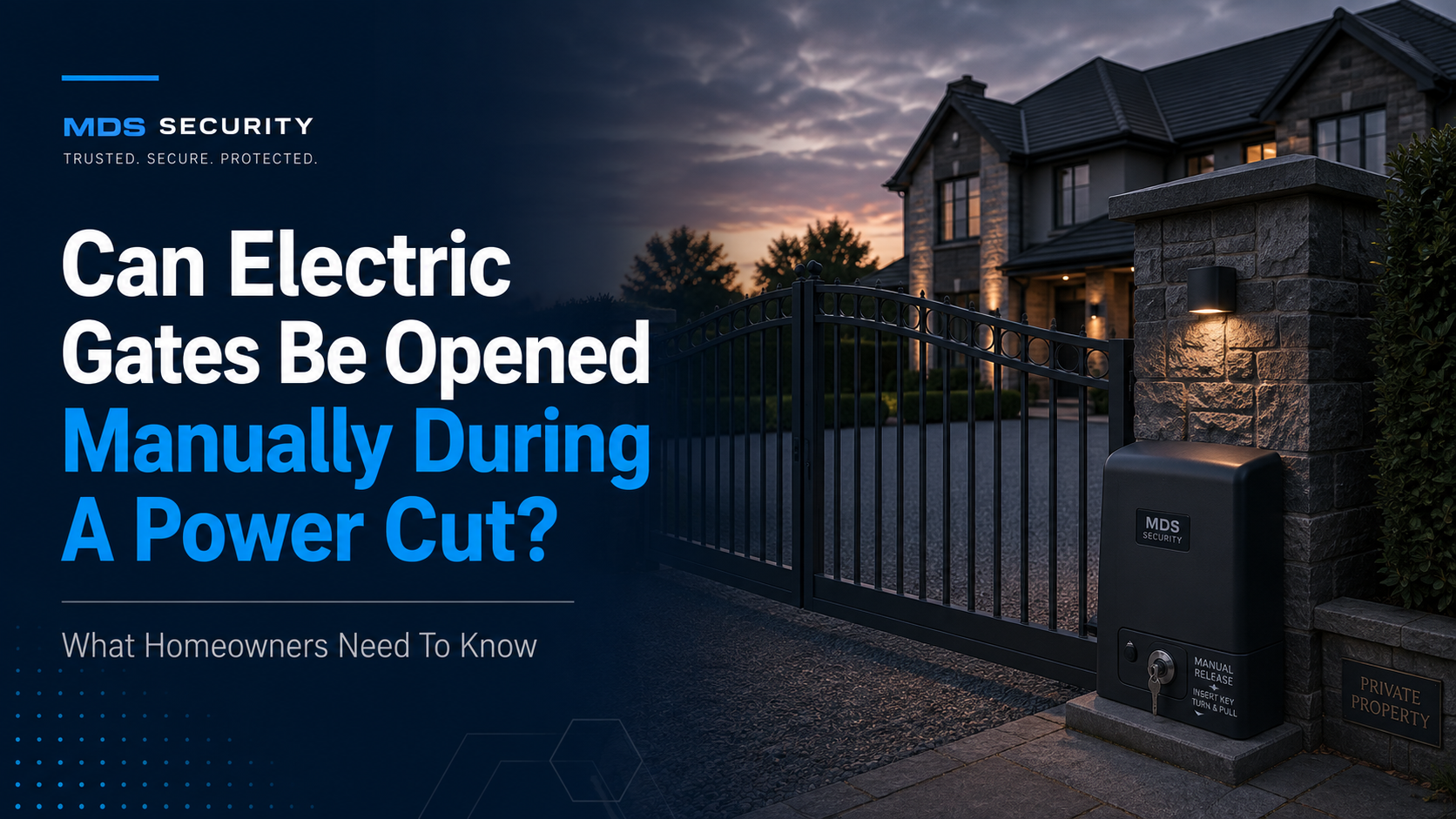
A power cut always seems to happen at the worst possible moment. You arrive home, press the remote and the gates refuse to move. So, can electric gates be opened manually during a power cut? In most cases, yes. Most electric gate systems include a manual release mechanism so the gate can be moved safely by hand when the motor has no power.
This guide explains how manual release works, where to find it, how to open swing and sliding gates safely, and when to call a professional.
Quick Answer
Nearly all domestic electric gates can be opened manually during a power cut using a manual release key, lever or emergency release mechanism. This disengages the motor so the gate leaf or sliding gate can move by hand.
The important point is that the gate should be released correctly. Forcing a gate that is still engaged can damage the gearbox, hinges, track or automation system, and may create a safety risk if the gate suddenly moves.
- Use the manual release key or lever supplied with the gate.
- Isolate the gate power before working near the motor, if safe to do so.
- Keep children, pets and vehicles away while the gate is being moved.
- Re-engage the motor properly before using the remote again.
- Call a professional if the mechanism is seized, missing or unsafe.
Why Electric Gates Stop Working In A Power Cut
An electric gate system usually includes the physical gate, motor, control panel, safety devices and access controls such as a remote, keypad, intercom or app. MDS Security installs and maintains automatic gates and domestic residential gates, so a safe power cut process should always be part of the installation.
When mains power fails, the motor and control board cannot operate normally. Some systems include battery backup, but not every gate has one. If no backup power is available, manual release allows the gate to move without damaging the equipment.
How Manual Release Works
The manual release mechanism disconnects the gate from the powered drive. Once released, the motor is no longer holding or moving the gate, so you can open or close it by hand until power is restored.
Most systems use a key-operated release, an allen key or shaped manufacturer tool, or a lever that disengages the drive gear. Some operators also include an emergency cord.
Keep the release key somewhere safe but accessible. A key locked inside the house is not much help if the only way to reach the house is through a closed gate.
Where To Find The Manual Release
Start by finding the motor housing. On swing gates, the motor may be an above-ground arm or an underground unit near the hinge. On sliding gates, it usually sits beside the gate track inside a lockable casing.
Above-Ground Swing Gate Motors
Above-ground motors are usually visible on the inside of the gate. Look for a ram arm, articulated arm or compact motor. The release point is normally behind a cap, cover or lockable section. This applies to many domestic swing gate installations.
Underground Motors
Underground motors sit in a foundation box at the base of each hinge. The release point is usually under a cover plate or access flap. Because these boxes sit at ground level, regular checks matter.
Sliding Gate Motors
On domestic sliding gates, the release is usually inside the motor housing or behind a lockable cover. Once disengaged, the gate should roll along the track by hand, but it may still be heavy.
How To Open Swing Gates Manually
Always use the manufacturer instructions where available. As a general guide, the process is usually:
- Isolate the power at the switch, fused spur or control panel if safe.
- Check the gate area and keep people, pets and vehicles clear.
- Insert the manual release key or tool into the release point.
- Turn the key and operate the release lever as instructed.
- Gently push each gate leaf by hand. Do not force resistance.
- Secure the gate open or closed so wind cannot move it unexpectedly.
If only one gate leaf releases, stop and check the second motor separately. Many double swing gates have a release point on each side.
How To Open Sliding Gates Manually
Sliding gates follow the same principle, but the movement is different:
- Turn off or isolate the gate power where possible.
- Unlock the sliding gate motor housing.
- Use the key, lever or release handle to disengage the drive.
- Hold the gate firmly and slide it slowly along the track.
- Keep hands, feet and clothing away from wheels, rack teeth and the track.
- Secure the gate once open so it cannot roll back unexpectedly.
If the gate is stiff, grinding or difficult to move, there may be a track, roller or motor fault. Book electric gate repairs, maintenance or servicing rather than forcing the system.
What If You Have Lost The Manual Release Key?
A lost key is frustrating, but do not force the gate. First, check whether the system has a tool-free emergency cord or lever. Then look for spare keys supplied at installation, including keys stored with manuals or handover documents.
If you still cannot find one, check the motor brand and model number so replacement keys can be ordered. Some gates can be released without a key if they have a tool-free release, but many cannot.
Can Battery Backup Avoid This Problem?
Yes, in many cases. A battery backup or UPS can keep an electric gate working during short power cuts, especially where the gate is the main vehicle access point.
Battery backup is not a replacement for safe manual release. Batteries age, and longer outages can still drain them. A good installation should give you both: backup power for convenience and a manual release method for emergencies.
Security During A Power Cut
When a gate is manually released, it may no longer provide the same level of security. If it is left open, your driveway becomes easier to access. If it is released but not secured, wind or gravity may move it.
For better protection, consider battery backup, suitable locking arrangements and a clear household plan. Do not assume a gate is secure during a power cut unless the lock has been specified and tested for that purpose.
Safety And Compliance Considerations
Powered gates need to be treated as machinery, not just driveway furniture. The HSE explains that powered gates are subject to product safety and health and safety law, and that risk assessment is vital because many installations are unique.
The HSE also advises that anyone working on powered gates is responsible for leaving the machinery in a safe condition. For a homeowner, that means not bypassing safety features, not forcing a seized motor and not leaving a manually released gate in a dangerous position.
Common Manual Release Problems
Manual release problems usually appear when the mechanism has not been used or serviced. Warning signs include a stiff key, corrosion, water ingress, a gate that feels unusually heavy, or a gate that will not re-engage.
These are not problems to ignore. A seized manual release can turn a small inconvenience into a real access issue during the next outage.
How To Re-Engage The Gate After Power Returns
Once the power is back, do not simply press the remote and hope for the best. Move the gate to the position recommended by the manufacturer, often fully closed. Return the release lever, key or handle to the engaged position, refit any covers, restore power and run one full open-and-close cycle while watching from a safe distance.
Stop using the gate and call an engineer if it grinds, judders, fails to stop correctly or will not respond.
How To Prepare Before The Next Power Cut
The best time to learn the manual release process is before a power cut. Find your key, label it clearly, store a spare where authorised household members can access it, and ask your installer to demonstrate the process at the next service.
It is also sensible to test the release mechanism periodically as part of maintenance, and to consider battery backup if access during outages is a regular concern.
When To Call MDS Security
Call a professional if the release key is missing, the mechanism has seized, the motor housing is damaged, the gate is too heavy to move safely, or the gate will not re-engage after power returns.
MDS Security can inspect your gate, service the manual release, diagnose motor or track faults, and advise whether battery backup is suitable for your installation. For help with electric gate servicing and repairs, or to discuss a safer setup for your hom