
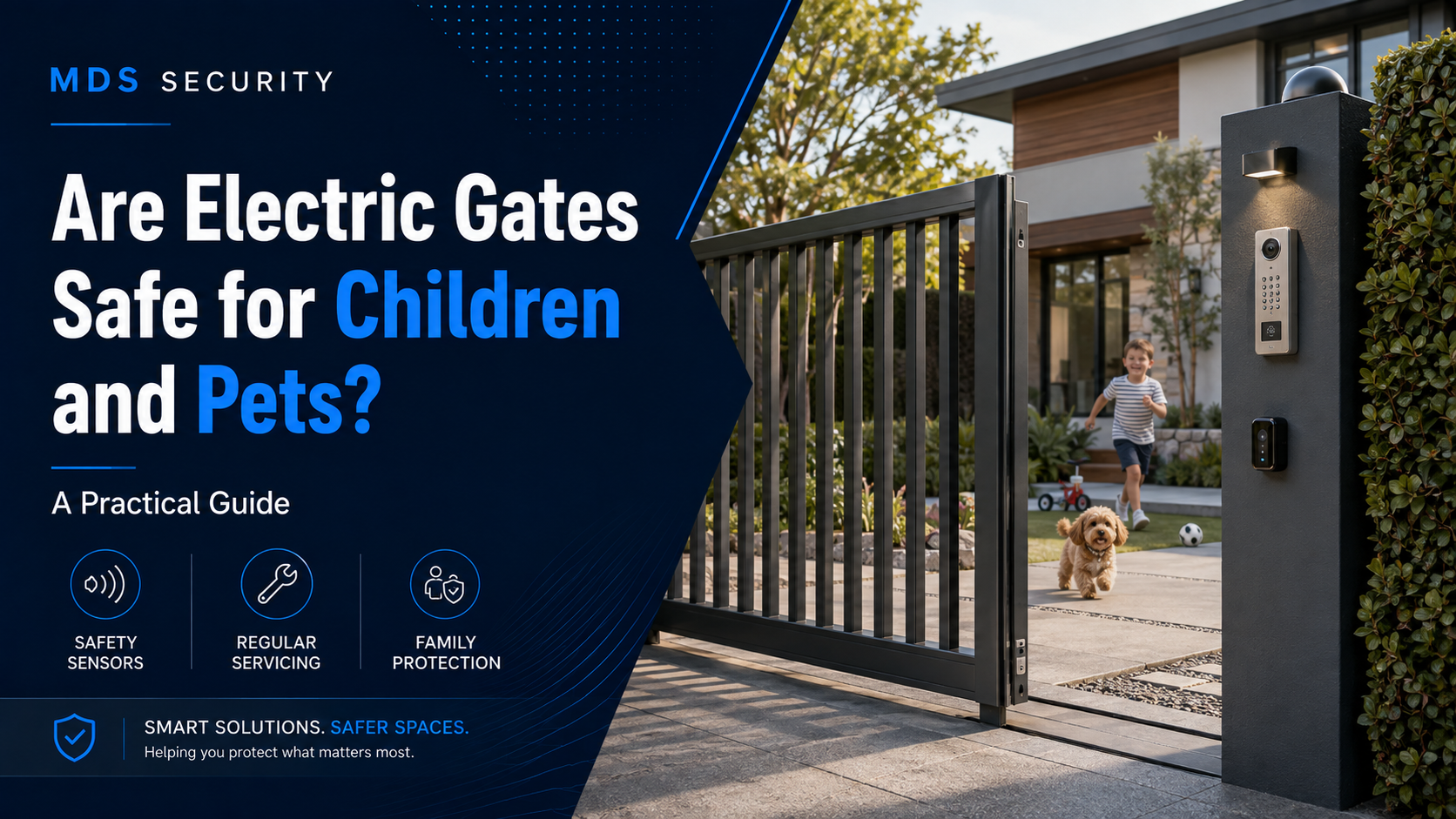
Yes, electric gates can be safe for children and pets, but only when they are designed, installed and maintained properly. The risk does not come from automation itself. It comes from poor installation, missing safety devices, weak risk assessment, or gates that have not been serviced for a long time.
This guide explains what families should look for before choosing or using automatic gates: the key safety features, warning signs, daily habits and when to ask MDS Security for an inspection.
Quick Answer: Are Electric Gates Safe At Home?
Electric gates are safe for homes with children and pets when they include the right mix of safety equipment. A safe system usually combines photocells, safety edges, force limitation, safe hinge design, warning signs and regular servicing.
No single feature is complete protection. The Health and Safety Executive explains that powered gates are often unique machines and that risk assessment is vital to their design and construction. Every gate should therefore be assessed in its own setting.
What Makes An Electric Gate Risky?
An electric gate is heavy and motorised. If the wrong system is fitted, it can create crushing, trapping, drawing-in or shearing risks, especially around hinges, closing edges, gaps between the gate and post, and sliding gate run-back areas.
Children and pets are more vulnerable because they move unpredictably. A child may run towards a closing gate or press a remote without understanding the danger. A dog or cat may pass below a poorly positioned beam. Family gates need layered protection, not just a motor and remote.
The Main Safety Features That Protect Children And Pets
The first key feature is a photocell. Photocells send an invisible beam across the gate opening. If a person, animal or vehicle breaks the beam, the gate should stop or reverse. For family homes, photocells should be positioned carefully so they protect likely crossing points rather than just detecting cars.
The second feature is a safety edge. These pressure-sensitive strips are fitted to moving edges or risk points. If the gate touches an obstruction, the edge compresses and sends a signal to stop or reverse. Gate Safe guidance strongly supports the use of photocells and pressure edges.
The third feature is force limitation. This controls how much force the gate applies if it meets resistance. However, force limitation should not be treated as a substitute for good design. HSE guidance notes that suitable risk assessment and safeguards are needed case by case, particularly where members of the public or vulnerable people may be present.
Extra Child Safety Measures To Consider
For homes with young children, the safest gate is one they cannot easily operate or play around. Keep remotes out of reach, as you would with car keys. If a keypad is used, mount it where small children cannot reach it and avoid easy codes.
Visual and audible warnings are also useful. A flashing light shows that the gate is about to move. A short sounder can add warning on busy entrances, although it should suit the setting.
Children should also be taught that gates are not climbing frames, toys or play areas. They should never ride on the gate, hold the bars while it moves, or stand between the gate and a wall, post or parked car.
Pet-Safe Electric Gates: What To Look For
Pet safety often comes down to detection height, timing and boundary control. A beam that detects vehicles may miss a small dog or cat, so ask whether low-level detection or extra safety edges are needed.
Automatic close timers can help prevent pets escaping through a gate left open, but the delay must allow safe passage. If your dog follows vehicles or waits near the entrance, mention this during the survey.
Also check the gap under and beside the gate. Good design considers both safe operation and secure containment.
Safety Standards, Compliance And Professional Installation
Powered gates should be designed and installed by competent professionals. The key standard often referenced is BS EN 12453, which deals with safe use of power-operated doors, gates and barriers. The installer should consider hinge areas, closing edges, posts, controls, pedestrian access and real use.
HSE guidance explains that people working on powered gates are responsible for leaving the machinery in a safe condition. Where a manual gate is converted, the installer may also take on product safety responsibilities for the finished machine.
The practical takeaway is simple: do not judge safety by whether the gate opens and closes. Ask for evidence that it has been risk assessed, fitted with appropriate safety devices, force tested and commissioned properly.
Maintenance: The Part Families Often Forget
A gate that was safe when installed can become unsafe if neglected. Photocells can become dirty, knocked out of line or blocked by plants. Safety edges can be damaged, and hinges, tracks and rollers can wear.
That is why electric gate maintenance and servicing is so important. For a domestic gate, arrange servicing in line with manufacturer guidance and usage levels. Homes with children, pets, shared access or frequent deliveries should be especially cautious.
Between services, keep photocell lenses clean, listen for unusual noises, check that the gate runs smoothly, keep vegetation clear and stop using the gate if it behaves unpredictably.
Warning Signs Your Gate May Not Be Safe
Call a professional if the gate keeps closing when something is in its path, stops at random, changes speed, makes grinding noises, catches on the ground, or has visible damage to cables, edges or hinges. Also get it checked if photocells have been hit or children can reach the controls.
If you think the gate is unsafe, isolate the power if it is safe to do so, keep children and pets away, and do not keep testing it repeatedly. A faulty powered gate should be inspected before normal use resumes.
What About Video, CCTV And Privacy?
Many modern gates include video intercoms, cameras or app-based access. These can improve safety because you can see who is at the gate before opening it. GOV.UK guidance explains that domestic CCTV or video doorbell systems may fall under data protection law if they capture images beyond your property boundary.
For households, point cameras sensibly, avoid unnecessary recording of neighbours and use privacy-friendly settings. Businesses and shared sites may have stronger data protection obligations.
FAQs About Electric Gates, Children And Pets
Are electric gates safe for homes with young children?
Yes, if they are professionally installed, risk assessed, fitted with suitable safety devices and maintained. Homes with young children should pay close attention to controls, hinge protection, photocells and safety edges.
Can electric gates detect small dogs and cats?
They can, but only if the detection system has been designed for that risk. Low-level photocells, suitable safety edges and careful automatic-close settings may be needed for homes with pets.
Should I test the gate myself?
You can clean sensors, check for obvious damage and watch how the gate behaves. Do not carry out force testing or electrical repairs yourself. Those checks need proper equipment and a competent engineer.
What should I do if my gate closes on something?
Stop using it, keep people and animals clear, and book an inspection. Even if nobody is hurt, the incident suggests the gate may not be detecting obstacles or limiting force correctly.
Are sliding gates or swing gates safer for pets?
Neither is automatically safer. The safest option depends on the layout, gap sizes, safety devices, controls and how the family uses the driveway. MDS can assess whether sliding gates, swing gates or another option is better.
Book An Electric Gate Safety Check With MDS Security
Electric gates can make family life easier and safer, but they must be treated as powered machinery rather than ordinary driveway furniture. The safest systems combine good design, reliable access control, properly placed safety devices and regular servicing.
If you are unsure whether your gate is safe for children, pets or visitors, contact MDS Security. Our team can inspect your existing gate, advise on upgrades, or design a new domestic residential gate system built around family safety.