
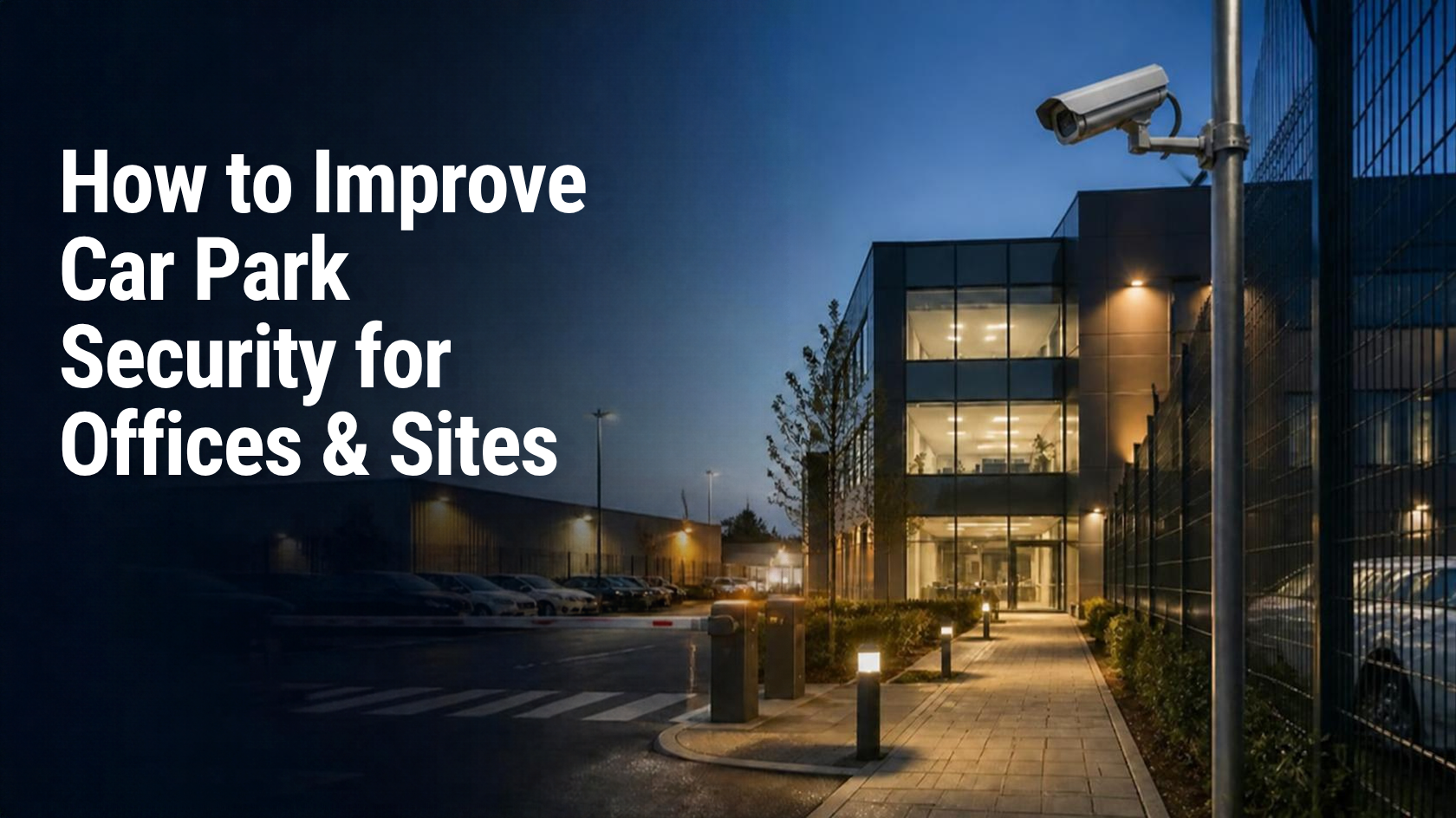
A poorly protected car park can quickly become a weak point for an office, industrial estate, warehouse, school, retail park or commercial site. It can invite unauthorised parking, vehicle crime, anti-social behaviour and avoidable safety risks for staff, visitors and contractors.
This guide explains how to improve car park security using a layered approach. That means combining access control, physical barriers, CCTV, lighting, pedestrian routes, signage, monitoring and maintenance into one joined-up plan.
The goal is not simply to make the site look secure. The goal is to control who enters, make movement safer, reduce blind spots, deter unwanted activity and give your team a clear way to respond when something goes wrong.
Quick Answer: What Is the Best Way to Improve Car Park Security?
The best way to improve car park security is to start with a site-specific risk assessment, then layer the right measures around the risks you find. For many commercial sites, that means controlled vehicle entry, good lighting, visible CCTV, clear pedestrian routes, secure boundaries and properly maintained barriers.
There is no single product that solves every car park security issue. A barrier may stop unauthorised vehicles, but it will not remove blind spots. CCTV may help with monitoring, but it will not physically stop tailgating. Fencing may protect the boundary, but it still needs controlled entry points.
A strong car park security plan uses each measure for the job it does best.
Start With a Car Park Risk Assessment
Before adding new equipment, walk the site and identify where the real risks are. A small office car park will not need the same solution as a busy distribution yard or multi-tenant commercial site.
Look at the site during normal working hours, after dark and during quieter periods. Common weak points include poorly lit corners, hidden pedestrian routes, open boundaries, unsecured service roads, unmonitored entrances, unclear traffic flow and areas where vehicles and pedestrians cross without clear separation.
Review any previous incidents too. Reports of theft, vandalism, unauthorised parking, tailgating, near misses or anti-social behaviour can show patterns that are easy to miss during a single site visit.
Once you understand the risks, you can prioritise the improvements that will make the biggest difference first.
Use Barriers to Control Vehicle Access
For many offices and commercial sites, the main security issue is simple: too many vehicles can enter too easily. Car park barriers help control access, manage traffic flow and make it clear that the site is private and monitored.
Automatic barriers are useful for busier entrances where authorised vehicles need smooth access throughout the day. They can work with fobs, keypads, intercoms, ANPR systems or staff-controlled access.
For quieter entrances or secondary access points, manual barriers may be a practical option. They provide a visible physical control without the same automation requirements.
Barrier placement is important. A barrier should stop unauthorised vehicles without creating queues, blocking emergency access or forcing pedestrians through unsafe areas. Where tailgating is a concern, the entrance layout should allow only one vehicle through per authorisation.
Add CCTV and Lighting for Better Visibility
Visibility is one of the most important parts of car park security. People are less likely to behave badly in a well-lit, monitored space, and users generally feel safer when they can see where they are going.
Good lighting should cover entrances, exits, walkways, payment areas, stairwells, loading areas and isolated corners. Avoid creating bright spots surrounded by dark areas, as this can reduce visibility rather than improve it.
CCTV systems should be positioned around key risk points, including vehicle entrances, pedestrian access points, parking bays, perimeter routes and any areas where incidents have occurred previously.
For commercial sites, CCTV should be treated as part of a wider monitoring and response process. Footage is only useful if cameras are positioned correctly, maintained properly and supported by clear procedures for reviewing and escalating incidents.
Secure the Boundary With Fencing and Perimeter Protection
If people can walk or drive onto the site without using the main entrance, barriers at the front will only solve part of the problem. The boundary matters too.
Fences and perimeter protection help define the site, discourage casual trespass and direct visitors towards controlled entrances. For higher-risk sites, fencing can also delay intruders and give staff or monitoring teams more time to respond.
Check for gaps in hedges, damaged fencing, low walls, unsecured service gates and hidden cut-through routes. These are often the places people use when they want to avoid the main entrance.
Perimeter security does not always mean making a site look harsh. The right design can combine practical protection with a professional appearance that suits offices, business parks and public-facing premises.
Separate Pedestrians From Vehicles
Car park security is not just about theft and unauthorised access. It is also about safety. Vehicles and pedestrians should be kept apart wherever possible.
Use marked walkways, crossing points, speed control, signage and physical separation to guide people safely from parking bays to building entrances. HSE guidance highlights the importance of keeping pedestrian and vehicle routes apart in workplace transport environments.
Where pedestrian entrances need tighter control, turnstiles can help manage who enters a site without relying only on vehicle gates. For perimeter entrances, a full-height fenceline turnstile can support controlled access while maintaining boundary security.
Good pedestrian planning also improves traffic flow. When drivers understand where people are likely to cross, the car park becomes easier and safer to use.
Consider Road Blockers for Higher-Risk Sites
Most office car parks do not need hostile vehicle mitigation, but some sites do. If a car park is close to a busy public area, critical building entrance, public venue, data centre, warehouse, high-value asset or crowded pedestrian route, the consequences of a vehicle impact may need to be considered.
In higher-risk settings, road blockers can provide stronger vehicle resistance than a standard car park barrier. They are not suitable for every site, but they can form part of a wider protective security plan where the risk justifies it.
Any higher-security vehicle control measure should be based on a proper risk assessment, site layout review and emergency access requirements.
Use Access Control for Staff, Visitors and Deliveries
Car park access control should make life easier for authorised users and harder for everyone else. This can include fobs, keypads, intercoms, visitor codes, staff permits, ANPR and controlled delivery access.
For sites with multiple entrances, several buildings or different user groups, access control helps keep permissions organised. Staff may need daily access, visitors may need temporary access and delivery drivers may need restricted access at certain times.
Automatic gates can also support controlled car park access where the site needs a stronger entrance solution than a rising arm barrier alone.
The key is to keep the system simple enough for daily use. If access rules are too complicated, staff may bypass them, prop open gates or share codes.
Do Not Forget CCTV and ANPR Compliance
CCTV and ANPR systems can collect personal data, so commercial sites need to think carefully about privacy and data protection. That means being clear about why cameras are used, where they are positioned, who can access recordings and how long footage is kept.
Clear signage should tell people that CCTV or ANPR is in use before they enter the monitored area. The ICO provides guidance for organisations using CCTV and video surveillance, including public awareness, signage, operation and data protection responsibilities.
A simple internal policy can help. It should cover the purpose of monitoring, retention periods, who can view footage, how subject access requests are handled and when footage may be shared with insurers or the police.
Create a Maintenance and Response Plan
Car park security systems only work if they are maintained. A barrier that sticks open, a camera that no longer records clearly or a broken access reader can quickly create a security gap.
Set a schedule for inspecting barriers, gates, CCTV cameras, lighting, signage, fencing, bollards and pedestrian routes. High-traffic sites may need more frequent checks than quieter office car parks.
Maintenance should be paired with a response plan. Staff should know who to call if a barrier fails, how to report suspicious behaviour, what to do after an incident and how to record problems properly.
Without a response process, even good security equipment can become passive rather than protective.
Practical Car Park Security Checklist
- Carry out a site-specific car park risk assessment.
- Review past incidents, complaints and near misses.
- Control vehicle entry with suitable barriers, gates or access systems.
- Improve lighting around walkways, entrances and isolated areas.
- Position CCTV to cover entry points, bays and blind spots.
- Secure weak boundary points with fencing or perimeter protection.
- Separate pedestrian routes from moving vehicles.
- Use clear signage for drivers, visitors and monitored areas.
- Check data protection duties for CCTV and ANPR.
- Schedule routine maintenance and staff reporting procedures.
Frequently Asked Questions
What is the best way to stop unauthorised parking?
The best approach is usually a combination of physical control and clear management. Barriers, gates, permits, signage, visitor procedures and monitoring all help reduce unauthorised parking. Signs alone are rarely enough if the site is easy to enter.
Do commercial car parks need CCTV signs?
Yes, if CCTV or ANPR is being used, people should be told that monitoring is taking place and why. Signage should be visible before people enter the monitored area.
How can offices make staff car parks safer?
Start with lighting, clear pedestrian routes, controlled access, visible CCTV and regular maintenance. Staff should also have a simple way to report faults, suspicious activity or near misses.
Are barriers better than gates for car parks?
Barriers are often better for managing regular vehicle flow, especially at busy entrances. Gates are usually more suitable where stronger perimeter control or out-of-hours closure is needed. Some sites benefit from both.
Secure Your Car Park With MDS Security
Improving car park security means more than installing one barrier or camera. The most effective sites use layered protection: controlled access, clear visibility, safe pedestrian routes, strong boundaries, compliant monitoring and regular maintenance.
MDS Security can help assess your office or commercial site and recommend the right combination of barriers, gates, CCTV, access control and perimeter protection.
Contact MDS Security today to book a site survey and create a practical car park security plan for your premises.