
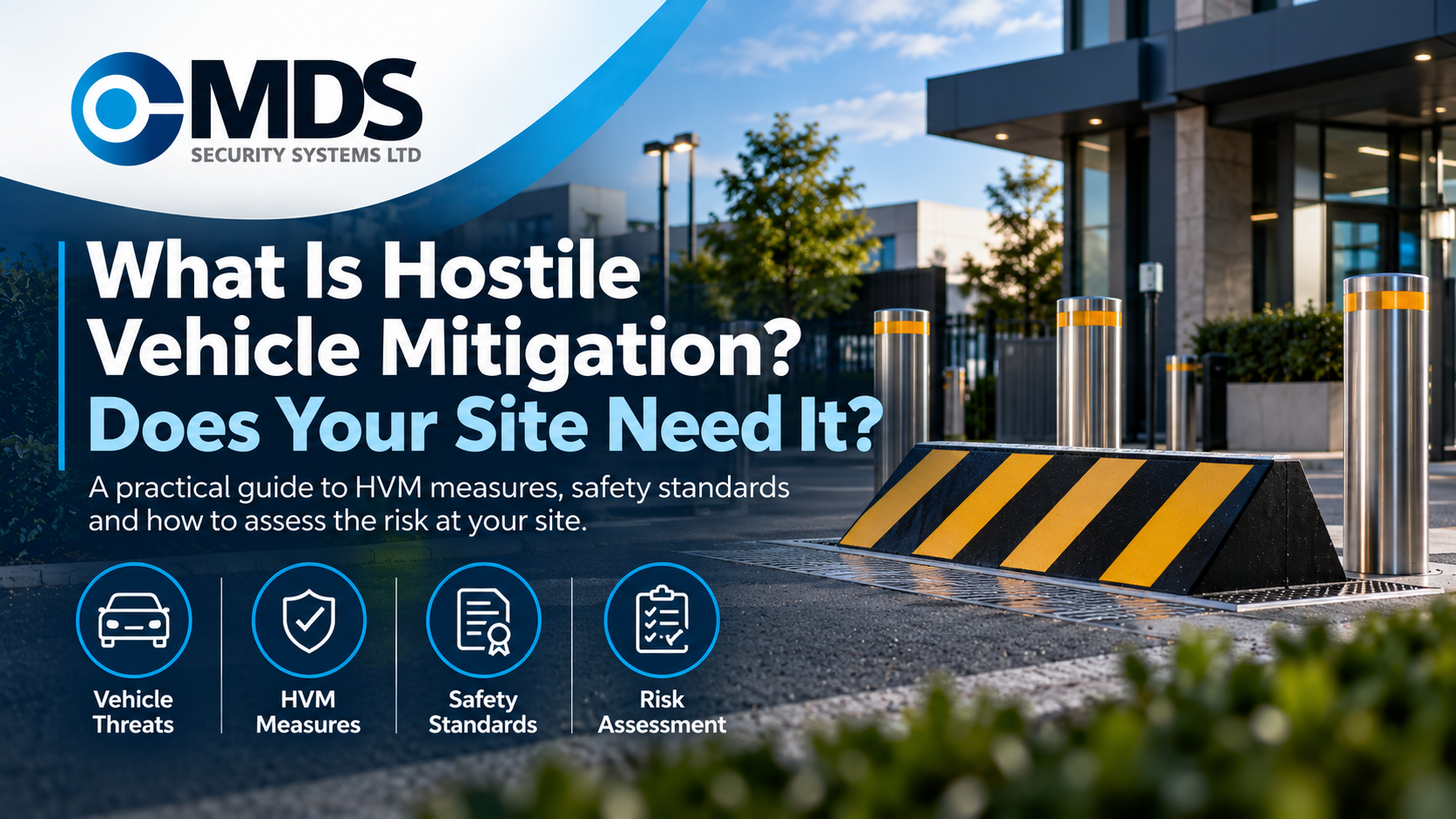
Vehicles can be used deliberately to injure people, damage buildings or disrupt operations. That is why venues, transport locations and some commercial premises assess whether vehicle access creates a serious security risk. But does every business park or office entrance need crash-rated barriers? No.
Hostile vehicle mitigation (HVM) is a risk-led approach to reducing vehicle-borne threats. This guide explains how it works, the difference between ordinary access-control equipment and tested vehicle security barriers, what an assessment involves and the likely cost considerations. It also explains when conventional site security may be more proportionate.
What Is Hostile Vehicle Mitigation?
HVM combines suitable physical measures, traffic management, site design and operating procedures to prevent, delay or limit vehicle attacks. It aims to protect people and assets while still accommodating legitimate traffic, deliveries, emergency access and pedestrians.
The National Protective Security Authority (NPSA) publishes specialist guidance on planning and evaluating these measures. Effective protection starts with understanding the site rather than choosing a particular bollard or barrier.
Which Vehicle Threats Does HVM Address?
Two key scenarios are a vehicle used as a weapon against people or property, and a vehicle carrying an explosive device. The appropriate response differs: a scheme might need to restrict vehicle speed and movement, stop a specified impact or maintain distance from a building. Ordinary accidental vehicle collisions may also be considered in a separate road-safety assessment.
Does Your Site Actually Need HVM?
There is no universal requirement for every commercial site to buy hostile vehicle barriers. The answer depends on who or what might be targeted, how vehicles could approach, the possible consequences and the safeguards already in place.
Locations That May Need Closer Assessment
- Stadiums, event venues and crowded public spaces where queues form beside roads.
- Government or high-profile facilities and some critical infrastructure.
- Pedestrianised areas with direct vehicle approaches or vulnerable gathering points.
- Sites where an assessment identifies a credible deliberate vehicle threat.
When Conventional Security May Be Enough
A low-footfall warehouse yard concerned mainly about unauthorised parking might benefit more from automatic barriers, controlled access, lighting and surveillance. A standard barrier can regulate vehicles but should never be assumed to provide impact-rated hostile vehicle protection. An assessment should explain why extra measures would or would not be justified.
HVM Barriers vs Ordinary Security Barriers
At a glance, a crash-tested road blocker and a conventional rising-arm barrier both control a road. Their verified performance can be very different.
Standard Vehicle Access Controls
Ordinary automatic gates and barriers manage authorised entry, deter casual intrusion and support traffic flow. They may not have been tested against hostile vehicle impacts. A heavy-looking product is not evidence of impact resistance.
Rated Vehicle Security Barriers
Specialist HVM products include tested fixed or retractable bollards, vehicle security barriers, road blockers and purpose-designed street furniture. Their documented performance relates to defined test conditions, including vehicle mass, speed, approach and penetration. A product’s rating must be considered alongside its installation and the proposed threat.
Why the Installed Foundation Matters
The foundation, ground conditions, spacing and anchoring can determine whether a system performs as intended. Ask whether the proposed installation matches the tested arrangement or is supported by an appropriate engineering assessment. MDS’s road blockers page introduces this product category, but product-specific HVM certification should always be confirmed before a security claim is made.
Which HVM Measures Are Available?
Fixed, Retractable and Temporary Barriers
Fixed bollards can protect permanently pedestrianised areas. Retractable bollards and active blockers permit controlled vehicle entry, provided they are correctly operated and maintained. Temporary tested systems may suit events, markets and short-term road closures where excavation is impractical.
Traffic Calming and Landscape Design
Changes to vehicle routes, bends and approaches may reduce attainable speed. Tested protective planters or street furniture can sometimes blend security into public spaces. However, an attractive planter or concrete block is not automatically crash-rated. Pedestrian accessibility, evacuation routes and emergency vehicles remain essential design considerations.
Limits of Temporary Protection
Some products are assessed for high-speed impact and others for resistance to repeated low-speed ramming. The NPSA explains that these test categories are not interchangeable. Check the intended scenario rather than relying on broad wording such as “anti-ram”.
What Do PAS 68 and ISO 22343 Mean?
PAS 68 is an established UK vehicle impact testing specification, and legacy ratings remain relevant when interpreting existing products. ISO 22343-1 is the newer international impact-test standard used for vehicle security barriers. Older IWA 14-1 ratings may also appear in specifications. PAS 69 has historically provided guidance for selecting and applying barriers.
Always request the complete test evidence and identify the tested vehicle, impact speed, penetration and installation arrangement. The NPSA’s temporary barrier guidance explains the distinction between impact ratings and vehicle attack delay testing.
How Is a Hostile Vehicle Risk Assessed?
A specialist assessment should identify assets, foreseeable threats, likely vehicle approach routes, surrounding roads and site vulnerabilities. For a higher-risk impact-protection project, appropriate vehicle dynamics analysis helps determine potential approach speeds and the performance needed from proposed measures.
Questions to Ask Before Specifying Equipment
- What specific threat is the scheme designed to address?
- Which entrances must remain usable by visitors, deliveries and emergency services?
- Can changes to road layout reduce speed before an impact point?
- What test evidence supports the proposed products and foundations?
- Who will operate, inspect and maintain the installation?
Consider integration with perimeter fencing and other existing controls rather than treating HVM as an isolated purchase.
How Much Does Hostile Vehicle Mitigation Cost?
There is no reliable single price for an HVM installation. A project with permanent foundations, underground services and controlled-access bollards can cost substantially more than a temporary event measure. Total cost depends on the threat specification, number of access points, civil engineering, utilities, drainage, traffic management, permits, maintenance and operational staffing.
Where Costs Are Often Underestimated
Groundworks and service diversions may exceed expectations. Active barriers also bring power, control-system and servicing costs. Procurement should compare whole-life costs and proof of performance, not simply the cheapest equipment quote. Sometimes changing a vehicle route or restricting access hours can be a more proportionate first step.
Does Martyn’s Law Require HVM?
The Terrorism (Protection of Premises) Act 2025, often called Martyn’s Law, introduces requirements for certain qualifying premises and events. Whether a location falls within scope depends on the legislation’s criteria, including use and capacity. It does not mean every business must purchase bollards or road blockers.
As of October 2026, the main operational duties have not yet come into force. Businesses can prepare by considering risk, relevant procedures and official guidance. See the Home Office factsheet for the implementation position and scope. Requirements should be checked again before publication or project decisions if the law changes.
Planning, Accessibility and Ongoing Operation
Permanent highway or public-realm measures may require highway authority consent, planning input and coordination with emergency services. Schemes must consider accessible routes, pedestrian congestion and safe evacuation. Active blockers need trained authorised operators, contingency arrangements for power failure and a maintenance plan.
For busy venues and publicly accessible locations, ProtectUK provides additional protective-security advice. Where warranted, consult an appropriately experienced independent HVM specialist or police Counter Terrorism Security Adviser.
Frequently Asked Questions
Do All Road Blockers Count as HVM?
No. Only equipment with appropriate evidence should be described as impact-rated for the specified vehicle threat. General access-control road blockers may have no relevant crash-test rating.
Can Temporary Barriers Protect an Outdoor Event?
Potentially. The solution must match the assessed threat, be deployed in the tested configuration and allow legitimate access. Temporary does not automatically mean suitable for every impact scenario.
Is HVM Only for Terrorism?
Hostile vehicle mitigation primarily addresses deliberate vehicle threats. Some layout or physical measures may also help with accidental vehicle risks, but those should be considered through appropriate road-safety design.
What Should I Do First?
Define the people, assets and access points you need to protect, review existing safeguards and seek a proportionate assessment before purchasing any purported HVM equipment.
Discuss Vehicle Security With MDS Security
Good HVM is about choosing proportionate protection, not making every site a fortress. MDS Security can discuss its available vehicle access and barrier solutions and help identify where specialist impact-rated advice or further assessment may be needed.
To review the entrance and perimeter security of your premises, contact MDS Security to discuss the site and the appropriate next steps.