
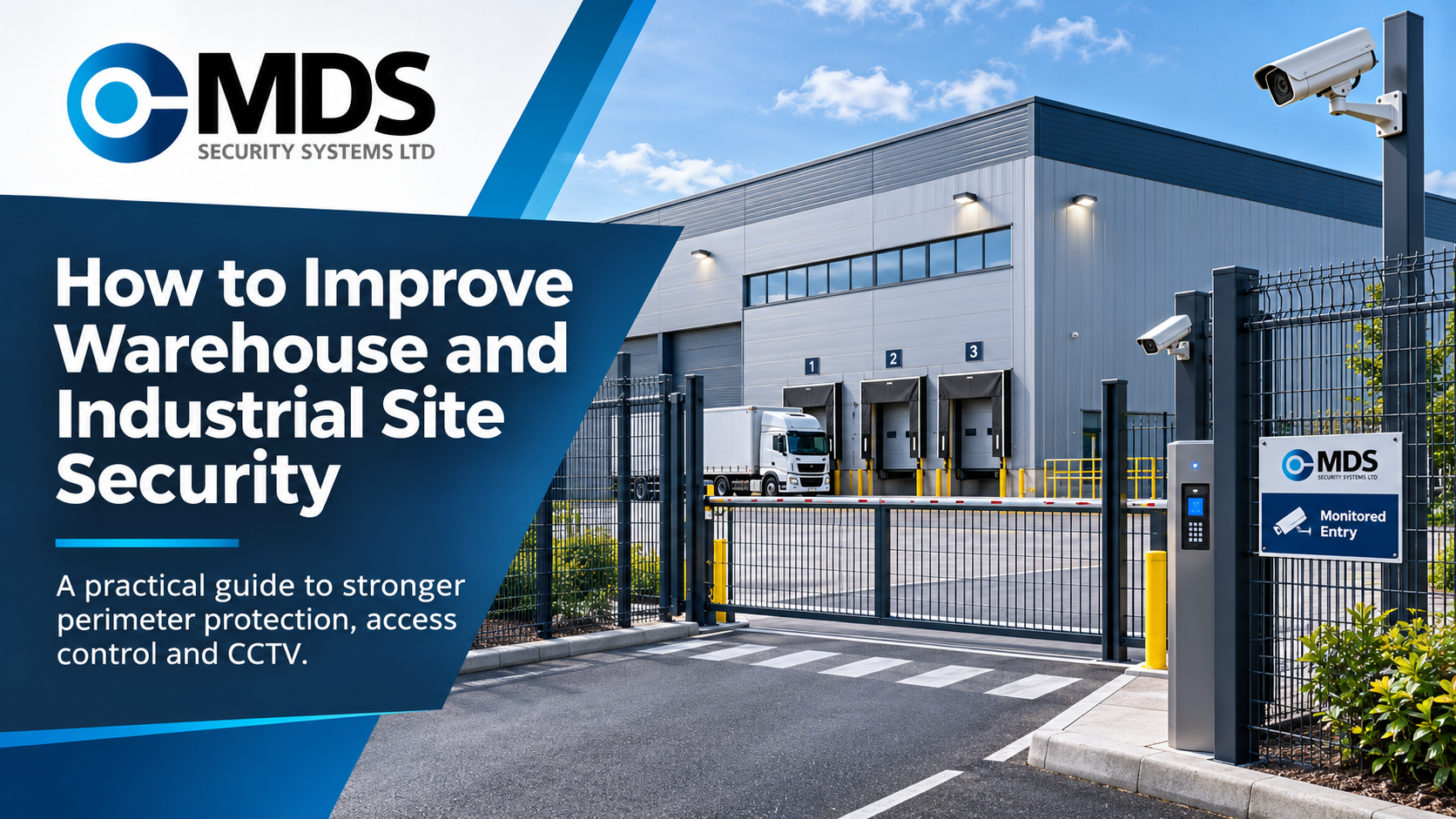
Warehouses concentrate stock, vehicles, equipment and valuable business information in one place. A weak gate, poorly controlled loading bay or unmonitored entrance can expose a business to theft, disruption and avoidable safety risks. The right warehouse security measures protect assets without slowing deliveries or making daily work unnecessarily difficult.
This practical guide explains how to assess your risks, choose physical security equipment, reduce inventory losses and plan upgrades within budget. It also distinguishes tasks your team can manage from those requiring specialist assessment or installation.
Quick Answer: What Makes a Warehouse Secure?
A secure warehouse uses several layers: a defined perimeter, controlled vehicle and pedestrian entrances, secure doors, appropriately positioned CCTV, managed access permissions and clear operating procedures. No single camera, fence or alarm can cover every vulnerability.
Start with the most serious risks, especially uncontrolled access, vulnerable loading bays and unsafe movement between people and vehicles. Then prioritise systems that suit the site’s hours, goods, traffic and budget.
Assess the Risks Before Buying Security Equipment
Examine the Boundary and Entry Points
Walk the site during working hours, at shift changes and after dark. Check damaged fencing, unlit corners, side entrances, roof access, doors left open for ventilation and routes hidden behind stored pallets. Record where unauthorised people or vehicles could enter and how quickly staff would notice.
Protect Stock and People Separately
Review losses, missing stock, previous incidents and high-value storage areas without assuming staff are responsible. Map forklift routes, lorry movements and pedestrian crossings at the same time. Theft prevention and workplace safety overlap, but they need different controls.
The Health and Safety Executive’s warehousing guidance explains why suitable traffic routes and separation between pedestrians and vehicles matter. Give each risk a likelihood, impact and named owner so improvements can be prioritised sensibly.
Secure the Warehouse Perimeter
Fencing, Lighting and Sightlines
A well-maintained boundary deters opportunistic access and guides drivers and visitors towards supervised points. Choose fencing and perimeter protection based on the site’s risk, neighbouring land, ground conditions and planning constraints, rather than specifying a universal fence height.
Keep vegetation away from cameras and gates, repair damaged panels promptly and use appropriate lighting around entrances and yards. Lighting should improve visibility without causing glare that reduces camera effectiveness.
Control Vehicles at the Entrance
Automatic barriers can manage authorised traffic at busy sites, while automatic gates may offer more substantial perimeter closure when the premises are shut. Neither is automatically an impact-rated hostile vehicle barrier. Specify safe opening distances, queueing room, emergency access and a suitable means of operating the entrance during faults or power cuts.
When a Standard Barrier Is Not Enough
At higher-risk premises, obtain specialist advice before considering road blockers or other vehicle-resistant measures. The required level of protection must follow an assessment rather than a product label.
Protect Doors, Loading Bays and Storage Areas
Prevent Unsupervised Access
Inspect shutter doors, locks, frames, personnel doors, roof hatches and accessible windows. Confirm they close reliably and that alarm contacts operate. Never make security modifications that obstruct a required escape route.
Manage Loading and Unloading
Loading bays deserve particular attention because goods, vehicles and external drivers meet there. Use designated driver waiting areas, marked pedestrian routes, delivery checks and controls that prevent unauthorised trailer movement. Keep equipment maintained and loading areas clear of unnecessary traffic.
The HSE’s loading guidance recommends keeping people not involved in loading away from the activity and providing stable, suitable areas for vehicles.
Protect High-Value Inventory
Place valuable or easily resold items in restricted cages or rooms, with controlled issue procedures and stock reconciliation. Security measures should complement the warehouse management system, not depend on cameras alone.
Use Access Control to Manage Staff and Visitors
Access control should reflect who actually needs each entrance. Individual fobs, cards or mobile credentials are usually easier to revoke and audit than shared keys or PINs. Allocate permissions by role, time and location, and remove access promptly when a contract or employment ends.
Use a separate procedure for drivers, temporary workers and contractors. Confirm identities and scheduled deliveries, issue time-limited permissions where practical, and keep visitors away from restricted stock areas. A controlled pedestrian gate can provide a safer route than sending staff through a busy vehicle entrance.
Do You Need Biometric Readers?
Not necessarily. Biometric systems can be appropriate for limited high-security applications, but involve additional privacy, accessibility and administration considerations. Conventional credentials with strong processes may be the more proportionate option.
Position CCTV for Useful Evidence and Monitoring
CCTV systems can cover vehicle entrances, external yards, loading bays and high-risk internal areas. Camera selection should consider lighting, image quality, viewing angle, storage, network resilience and who responds to alerts. Test actual footage at the distances needed to identify events.
Make Monitoring Lawful and Proportionate
Tell staff and visitors about monitoring, restrict footage access and explain its purpose. A fixed 30-day rule does not exist under UK GDPR: retention should be no longer than needed for an identified purpose. The ICO’s surveillance guidance explains retention and security requirements.
Can CCTV Prevent Employee Theft?
It may help deter wrongdoing or establish facts, but cameras cannot replace fair investigations, stock controls and clear policies. Worker monitoring must be necessary, transparent and proportionate; do not assume surveillance proves an individual’s responsibility for missing stock.
Connect Alarms, Access and Response Procedures
Intrusion alarms, door contacts and access events become more useful when someone is responsible for checking and responding. For example, an after-hours door alarm could prompt a camera review and an agreed call-out. Test these workflows, including false alarms and connectivity failures.
Keep connected security equipment updated and separate it from general office networks where appropriate. Apply strong passwords, restricted administrator accounts and multifactor authentication for remote access. Ask suppliers about ongoing software support before purchasing.
Warehouse Security Costs: What Affects the Budget?
There is no reliable single price for securing a warehouse. Costs depend on site area, fence length, gate and barrier specifications, available power, groundwork, camera coverage, network infrastructure and whether monitoring is staffed or outsourced.
Spend First on the Biggest Weaknesses
Low-cost steps may include repairing damaged fencing, improving door-control routines, removing obsolete access permissions, clearing sightlines and marking safe routes. More substantial investment may be justified for entrance automation, CCTV expansion or secure storage.
Questions to Ask Before Accepting a Quote
Request a written scope showing equipment, installation work, commissioning, warranties, ongoing licences and maintenance. Ask what happens during a power failure, how faults are reported and which tasks are excluded. Compare total ownership costs, not simply the installation price.
Train Staff and Maintain Your Security
Give every shift a straightforward opening, closing and incident-reporting procedure. Train people to report propped-open doors, damaged fencing, suspicious visitors and missing credentials without making unsubstantiated accusations. Review security arrangements after significant changes in stock, occupancy or working hours.
Inspect hardware and camera performance at intervals suited to risk and usage. Do not replace equipment simply because it reaches a fixed age; review condition, software support and service history. Where appropriate, use MDS Security’s services to discuss system improvements or ongoing support.
Frequently Asked Questions
What Is the Best First Step for Warehouse Security?
Carry out a practical risk assessment. Identify uncontrolled access, high-value stock, weak boundaries and vehicle–pedestrian conflicts before choosing products.
Are Security Cameras Enough to Protect a Warehouse?
No. CCTV supports detection and investigation but works best alongside secure entrances, good lighting, inventory controls and a response process.
How Often Should Warehouse Security Be Reviewed?
Set inspection and servicing schedules according to site risk, equipment requirements and operating intensity. Review the wider plan after incidents, changes in use or major building alterations.
How Do You Improve Security Without Disrupting Deliveries?
Separate vehicle and pedestrian routes, establish clear driver instructions and specify entrance controls around actual traffic peaks. Pilot changes before expanding them across the site.
Improve Warehouse Security With MDS Security
Effective warehouse security is layered, practical and proportionate. Strong boundaries, carefully designed entrances, useful CCTV, controlled access and staff procedures work together to reduce avoidable risks while keeping goods moving.
If you are reviewing an industrial site, contact MDS Security to discuss a site assessment and suitable perimeter or access-control solutions.