
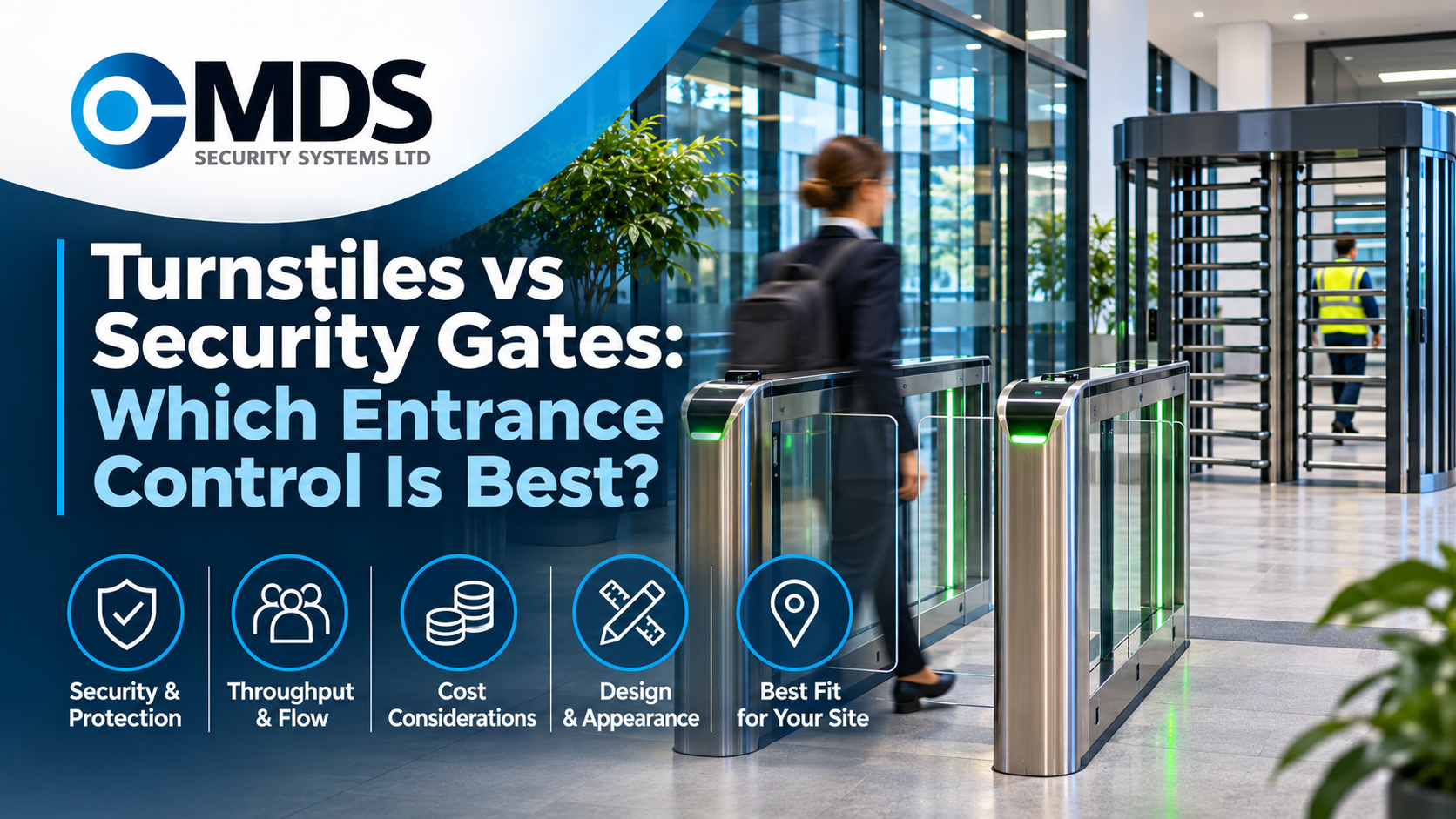
Choosing between turnstiles and security gates is not simply a matter of appearance. A busy office reception, an industrial perimeter and a leisure centre all need different levels of control. The right choice must balance unauthorised entry, pedestrian movement, accessibility, emergency escape and running costs.
Quick answer: A full-height turnstile can provide a substantial physical deterrent at an industrial perimeter. Tripod turnstiles offer straightforward controlled entry, while motorised speed gates suit monitored receptions where presentation and visitor experience matter. No option is automatically best for every site.
What Is the Difference Between Turnstiles and Security Gates?
Turnstiles: a mechanical restriction on passage
A turnstile allows pedestrian movement using rotating arms or a full-height rotor. A card reader, keypad or another approved credential can release the mechanism for an authorised user. The turnstiles offered by MDS Security are relevant to controlled commercial and industrial entrances where the number of people entering needs managing.
Speed gates: powered panels with sensors
Speed gates usually use sliding or swinging panels, often with glass finishes, alongside sensors that monitor movement through a lane. They can signal suspected tailgating and connect with visitor-management systems. Some designs provide a meaningful physical barrier, but their resistance varies considerably by product.
Why the terminology matters
“Security gate” may also describe a pedestrian swing gate or an external perimeter gate. When comparing quotes, ask suppliers exactly which equipment they mean, because an optical lane with no physical panels behaves differently from a motorised speed gate.
Which Gives Better Physical Security?
For an exposed, unattended boundary, a well-specified full-height turnstile is often more restrictive than a waist-high tripod model or an optical lane. It discourages people from stepping over or passing underneath, although its overall security depends on surrounding fencing, installation, supervision and response procedures.
MDS provides a dedicated full-height fenceline turnstile solution for environments such as industrial sites and other controlled pedestrian access points. Assess the adjacent fence and emergency arrangements as carefully as the rotor itself.
What about tailgating?
Sensors can identify some attempts to follow another user through a lane without authorisation, but detection is not guaranteed prevention. A meaningful response might include an audible alert, CCTV review or staff intervention. Similarly, a turnstile reduces opportunities for casual tailgating without making unauthorised passage impossible.
Turnstiles vs Speed Gates: Comparison at a Glance
| Factor | Turnstiles | Speed gates |
| Typical location | Perimeters, gyms, industrial access | Offices and managed receptions |
| Physical restriction | Varies; full-height types can be substantial | Varies by panel design and height |
| Visitor experience | Functional, sometimes slower or more restrictive | Often more open and visually refined |
| Accessibility | Usually needs a separate accessible route | Accessible lane options available |
| Cost | Depends on model, site and installation | Often greater integration and servicing complexity |
How Much Pedestrian Throughput Do You Need?
Peak flow matters more than a headline manufacturer capacity. Consider the number of people arriving in a five- or fifteen-minute period, the time needed to present credentials, visitor assistance and the chance that an access request is rejected.
For a factory shift change, calculate the queue likely to form at the busiest entrance. For an office reception, include contractors, guests and people carrying bags. Ask the installer to demonstrate the intended lane configuration against real demand instead of relying on generic hourly throughput figures.
Where speed gates can help
Motorised lanes often suit a reception where many authorised staff pass through and a security or reception team is available to manage exceptions. Their open appearance can also complement a contemporary commercial interior.
Where turnstiles can help
At a fenced boundary, controlled rotation may be more important than appearance. Full-height equipment can help channel people through one supervised or credential-controlled point, but can be unsuitable where large items regularly need moving through.
Accessibility and Safe Emergency Escape
One of the biggest specification mistakes is treating the standard lane as the only route. People using wheelchairs, mobility aids, pushchairs or delivery trolleys must be considered from the outset, together with the building’s evacuation strategy.
A separate pedestrian gate or accessible lane may be needed alongside turnstiles. Door widths, controls, turning space and assisted access should be assessed for the actual site. England’s Approved Document M guidance explains the building accessibility framework.
Do barriers always open during a fire alarm?
Do not assume every turnstile automatically unlocks or opens in exactly the same way. The design must be coordinated with the fire-risk assessment, escape strategy and applicable building requirements. A site may need an independent escape route that remains usable even if powered access equipment fails.
How Do Turnstiles Work With Existing Access Control?
Access can be authorised through cards, fobs, PINs or supported mobile credentials. Whether a particular reader or controller works with a proposed gate depends on interfaces, licensing, wiring and software configuration. Check interoperability before ordering, particularly when upgrading an occupied building.
Useful supporting systems
A wider solution can include CCTV systems to review incidents, visitor intercoms for reception assistance and alerts for repeated denied access. These tools can help staff respond, but their effectiveness still depends on procedures and maintenance.
Data handling considerations
If access logs or video identify individuals, decide why they are collected, who may view them and how long they are retained. The Information Commissioner’s Office provides relevant guidance for surveillance and personal data.
What Are the Costs and Trade-offs?
There is no meaningful one-price answer without the opening dimensions and system requirements. The final quote may include foundations, electrical supply, readers, control integration, accessible routes, fire interfaces, commissioning and ongoing servicing.
Tripod turnstiles may involve a smaller initial equipment investment than premium glass speed gates. Full-height equipment can require more substantial civil work and perimeter integration. Speed gates can introduce motors, sensors and finishes that need specialist support. Neither format is automatically cheaper to maintain.
What should be included in the quotation?
Ask for itemised equipment and installation costs, proposed safety tests, software licences, warranties, replacement-part availability and a service schedule. Confirm whether the installer is including the accessible route and any changes to existing CCTV or building access controls.
Which Option Fits Your Building?
Warehouses and industrial estates
Where the priority is a managed pedestrian entry through a secure boundary, full-height turnstiles may suit the risk profile. The overall approach should work with fences and perimeter protection and allow legitimate visitors, deliveries and emergency access.
Office receptions
Speed gates may be more suitable where a welcoming entrance, steady staff movement and visitor assistance matter. A staffed reception can investigate alerts that an unattended lane might only record.
Schools, leisure facilities and public buildings
Prioritise predictable routes, the needs of all users, safeguarding or operational requirements and suitable escape arrangements. Avoid introducing restrictive equipment solely because it appears more secure.
Questions to Ask Before Installation
- What threat or access problem are we trying to solve?
- How many people arrive during the busiest period?
- Who needs an accessible or assisted route?
- How does the system work during a power failure or evacuation?
- Will it integrate with our existing access controls and cameras?
- Who responds to alarms and maintains the equipment?
Frequently Asked Questions
Are full-height turnstiles more secure than speed gates?
They can provide a stronger physical restriction in some applications, but security depends on the specification, surroundings and operation. A risk assessment should decide the required level.
Can one system control both types?
Often yes, provided the controllers and interfaces are compatible. Have your installer confirm supported integrations rather than assume every product works together.
Do speed gates stop tailgating?
Many detect potential tailgating and generate alerts. Detection accuracy and physical prevention depend on the model, settings and site procedures.
Discuss Entrance Control With MDS Security
Choosing between turnstiles and security gates should begin with your entrance layout, security risks, pedestrian flow and budget. MDS Security can discuss the practical options available for your premises and whether a full-height turnstile or alternative controlled gate arrangement is appropriate. Contact MDS Security to arrange an enquiry or site discussion.