
If you are planning a new secure entrance, one choice matters more than most: should you choose a cantilever gate or a tracked sliding gate system? Both options are types of sliding gates, but they operate in different ways and suit different sites.
This guide explains the key differences between cantilever and tracked sliding gates, including space requirements, ground conditions, cost, security, automation and maintenance. By the end, you should have a clearer idea of which system is best for your property.
Quick Answer: Which System Should You Choose?
The main trade-off is simple. Cantilever gates usually cost more and need more run-back space, but they work better on uneven ground, gravel, mud, leaves and high-use entrances. Tracked sliding gates usually cost less and take up less side room, but they need a clean, level ground track to operate reliably.
For most residential properties with a flat driveway and limited side space, tracked sliding gates can be a practical and cost-effective choice. For commercial sites, busy entrances, uneven surfaces or areas where debris may collect, cantilever sliding gates are often the stronger long-term solution.
If you are still deciding between gate layouts, you may also find our guide useful: Sliding vs Swing Gates: Choosing The Right Gate Type.
How Each Sliding Gate System Works
Both options are sliding gate systems, but they carry the gate’s weight in different ways. That affects installation, wear, maintenance and long-term durability.
Cantilever Sliding Gate Mechanics
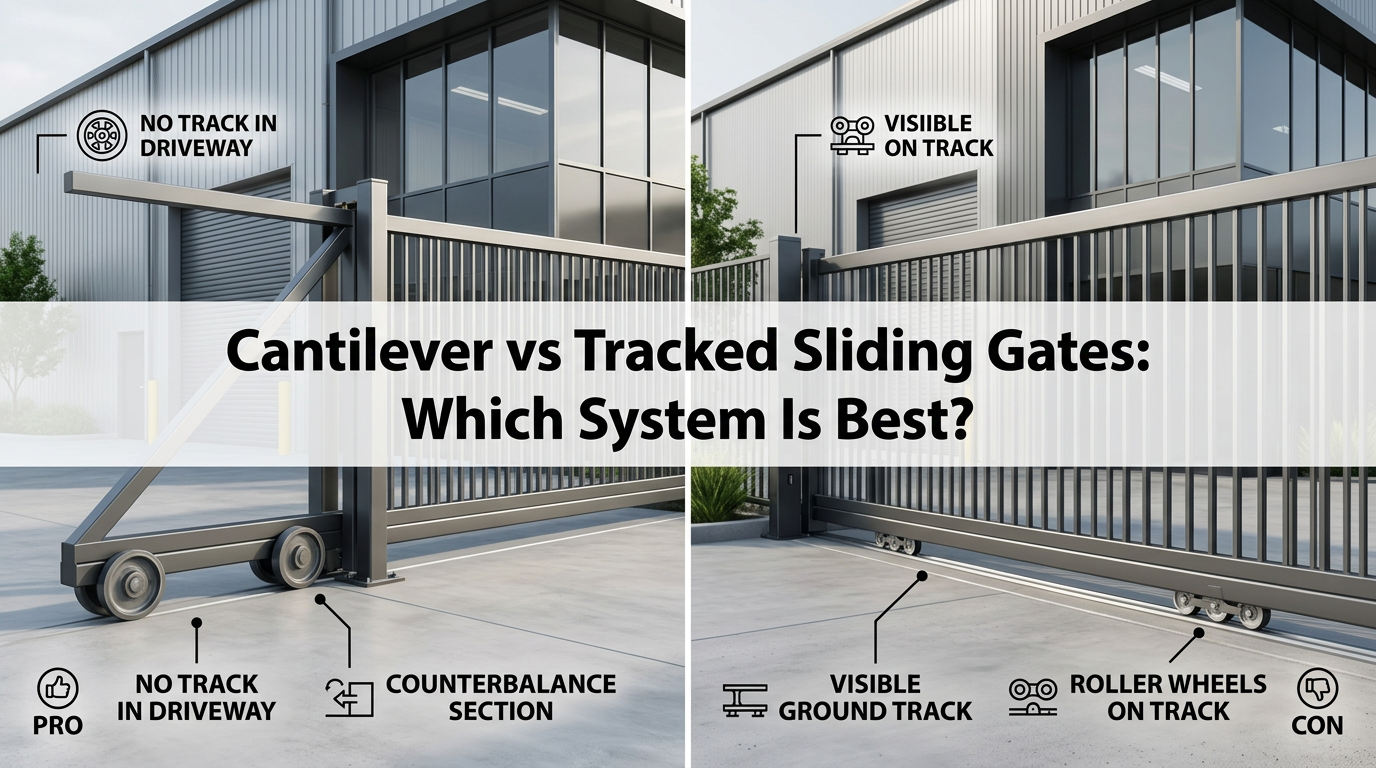
Cantilever sliding gates do not touch the driveway surface across the entrance. Instead, the gate is supported by rollers within a strong support structure at one side of the opening. A counterbalance section, often called the rear tail, keeps the gate stable as it moves.
Because this system is trackless, the gate glides above the ground. This makes cantilever gates ideal for uneven ground, gravel driveways, mud, leaves and areas where a ground track could become blocked. The main downside is that the gate needs extra side room to accommodate the counterbalance section.
Tracked Sliding Gate Mechanics
Tracked sliding gates move on wheels along a fixed ground track. The gate’s weight is carried through the lower frame into the track below, making the system compact and often more affordable to install.
A tracked system works best where the driveway is flat, stable and suitable for a straight rail. If the entrance already has a good concrete base, tracked sliding gates can be very space efficient. However, the track must be kept clear to maintain smooth operation.
What Is the Difference Between a Cantilever Gate and a Sliding Gate?
A cantilever gate is a type of sliding gate. All cantilever gates are sliding gates, but not all sliding gates are cantilever gates.
A cantilever gate uses a suspended, trackless design with a counterbalance. A tracked sliding gate uses wheels running along a visible ground track. When people compare cantilever vs tracked sliding gates, they are comparing two different systems within the sliding gate family.
Site Suitability: Space, Slope and Ground Conditions
Your site layout plays a major role in choosing the right system. Before choosing a gate, you need to consider side clearance, driveway surface, slope, drainage and how often the gate will be used.
When Cantilever Gates Work Best
Cantilever gates are ideal where the site has uneven ground, loose gravel, drainage channels, mud or frequent leaf build-up. They also suit sloped driveways, decorative paving and places where a ground track would be difficult to keep clear.
Because the gate is suspended, the system avoids many of the problems that affect tracked gates. This makes cantilever sliding gates a strong option for commercial properties, high-use entrances and homes where long-term reliability matters most.
When Tracked Sliding Gates Work Best
Tracked sliding gates are best suited to flat, solid surfaces where the track can remain level and clear. They usually need less side room than cantilever systems because there is no large counterbalance section.
That makes tracked sliding gates a good fit for many residential and commercial properties with simple layouts. If the driveway is straight, the ground is stable and debris is limited, tracked gates can be an excellent choice.
Learn more about our sliding gate systems and how they can be tailored for residential and commercial properties.
Ground Track Details and Site Limits
A ground track must be fixed to a stable base. During installation, the track needs to be set and anchored so it remains straight and level. If the base moves, the gate may bind, wear faster or place strain on the motor.
This is particularly important on block paving, decorative driveways and areas with drainage issues. Standing water, leaves, stones and ice can all interfere with a track. For reliable use, a clean and level track is essential.
Cost, Maintenance and Durability Comparison
When comparing cost, look beyond the gate hardware. You also need to consider installation, groundworks, servicing and likely repairs over the lifetime of the system.
Tracked sliding gates often cost less upfront. They use a simpler frame, usually require a shorter gate structure and can be easier to fabricate. For budget-conscious residential projects on flat ground, tracked systems can be attractive.
Cantilever gates usually cost more at the start. The heavier frame, stronger support structure, larger posts and concrete footings all add to the price. However, they often require less track-related maintenance because there is no rail in the driveway collecting debris.
For demanding sites, cantilever gates can offer better long-term value. For lighter-use properties with flat ground, tracked sliding gates may remain the more cost-effective option.
You can also compare average pricing in our full guide: UK Electric Gate Costs: Prices, Installation & Running Costs.
Maintenance Schedule and Servicing Needs
All automated gates need regular checks for performance and safety. The difference is where the maintenance tends to happen.
With tracked sliding gates, homeowners and site managers should inspect the track, remove stones, leaves and mud, and check the wheels for wear. Because the moving parts sit closer to the driveway surface, maintenance is often more frequent.
With cantilever gates, the guide posts, lower beam and rollers should be checked regularly. These systems often need less day-to-day clearing, but they still require professional servicing.
Monthly visual checks and professional maintenance every 6 to 12 months are sensible for both systems. Keeping a service record can also support warranties, insurance and long-term compliance.
Automation, Electric Sliding Gates and Access Control
Modern electric sliding gates can be fitted with a wide range of automation and access control options. The best setup depends on gate size, traffic levels and how the site is used.
Most electric sliding gates use a sliding gate operator with a rack-and-pinion drive. For homes, a moderate-duty operator may be enough. For busy commercial entrances, heavier-duty equipment is usually recommended.
Useful Automation Options
- Keypads for visitor entry
- Fobs and remotes for everyday access
- Intercom systems for controlled entry
- Timers and event controls
- Battery backup for power loss
- Remote monitoring for service alerts
The best automation system is not simply the strongest or most expensive option. It is the system matched to the gate weight, duty cycle and site conditions. For most homes, reliable remote access, keypad entry and obstacle sensing are enough. For commercial properties, stronger motors, better logging and integrated access control systems may be worth the additional investment.
Safety Standards and Compliance Checks
Automated gates must be designed and installed safely. That means using suitable guarding, force limitation and obstruction detection.
Key safety features may include:
- Photo eyes or photocells
- Safety edges
- Emergency stop or manual release options
- Correct force testing
- Clear handover documentation
Good safety design protects users and helps protect the property owner. Whether you are installing gates for a home or a business, ask your installer to explain how the system complies with current safety standards.
Security Considerations
Both cantilever and tracked sliding gates can provide excellent security when specified correctly.
Cantilever gates are often preferred for high-security and busy commercial sites because they are robust, difficult to obstruct with debris and designed for frequent use.
Tracked sliding gates can also be highly secure, especially where the driveway can support a strong track and heavy gate design. Security can be improved further with anti-tamper hardware, secure locking, monitored entry points and integrated access control.
Right Installer Checklist
Choosing the right installer matters as much as choosing the gate system. A good installer should recommend the best option for your site, not simply the easiest option to fit.
Before choosing an installer, ask for:
- A full site survey with measurements and levels
- Checks for posts, footings and ground conditions
- Proof of insurance and relevant certifications
- Examples of similar sliding gate projects
- A written quote with scope, exclusions and warranty terms
- A maintenance plan and emergency response process
Sliding Gate Installation Across the North West
At MDS Security Systems, we design and install tracked and cantilever sliding gates across the North West, including:
Our team can assess your driveway layout, ground conditions and security requirements to recommend the most suitable sliding gate system for your property.
Final Recommendation: Cantilever or Tracked Sliding Gates?
When comparing cantilever vs tracked sliding gates, start with four things: available space, ground conditions, budget and security requirements.
Choose tracked sliding gates if you have a flat driveway, limited side space and want a more cost-effective installation. Choose cantilever gates if you have uneven ground, gravel, debris, drainage issues or a busy entrance where long-term reliability is more important than the lowest upfront cost.
Need Help Choosing the Right Sliding Gate System?
Choosing between cantilever and tracked sliding gates is easier with a professional site survey.
At MDS Security Systems, we provide tailored recommendations for residential and commercial properties across the North West. Our experienced team will assess:
- Driveway width and side clearance
- Ground conditions and drainage
- Expected usage levels
- Automation and access control requirements
- Long-term maintenance considerations
Contact MDS Security Systems today to arrange a free site survey and receive expert guidance on the best sliding gate solution for your property.