
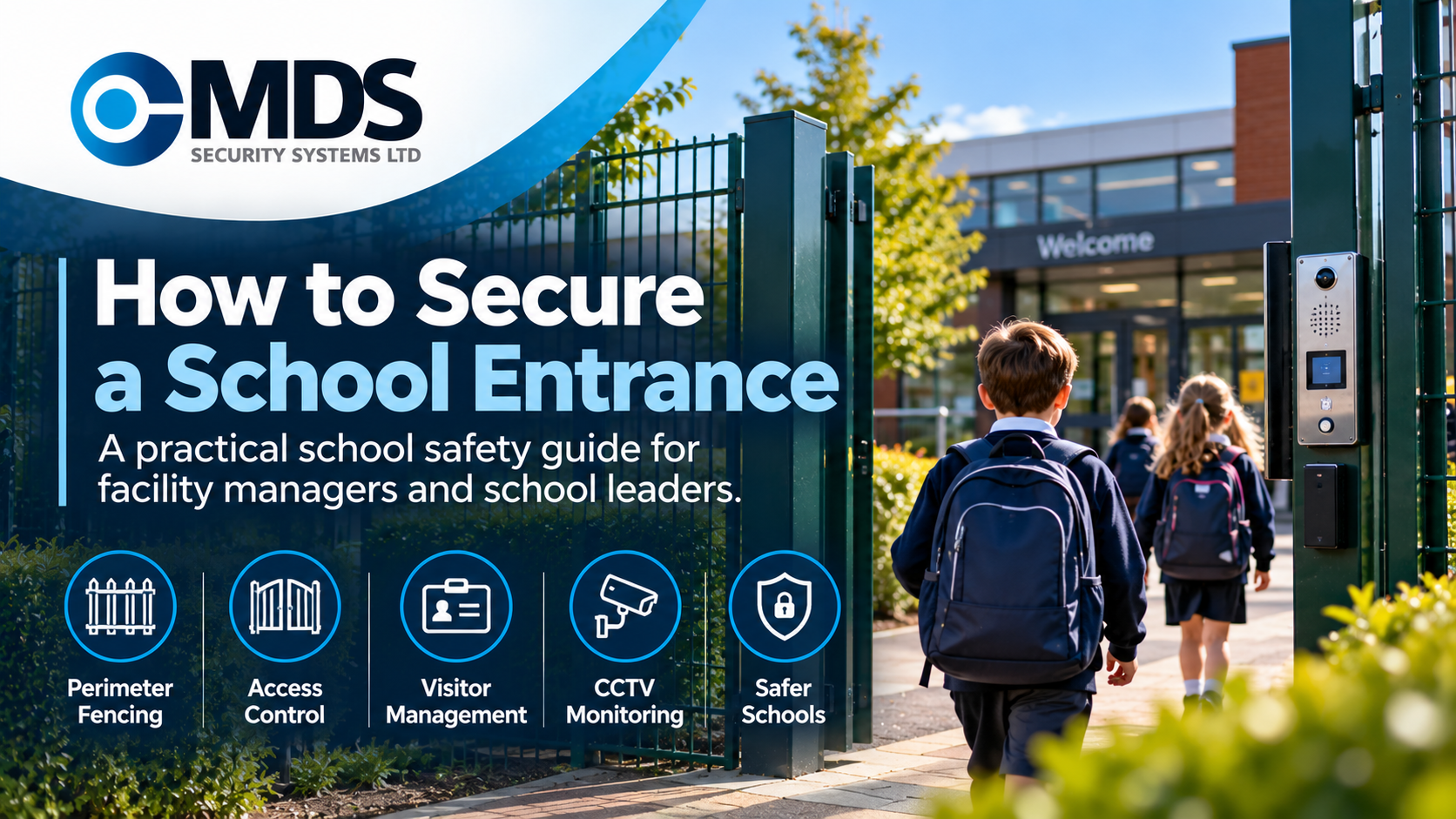
A school entrance must welcome pupils, parents and visitors while protecting everyone inside. That balance becomes difficult at busy drop-off times, during deliveries or when several buildings share the same grounds. Effective school entrance security starts with a realistic assessment of risks, not a shopping list of equipment.
This guide is for headteachers, school business managers, facilities teams and governors. It explains what to prioritise, where gates and technology can help, what they cannot do and when a specialist assessment is worthwhile. The advice focuses on schools in England; requirements and guidance elsewhere in the UK can differ.
Quick Answer: How Do You Make a School Entrance Safer?
Start by identifying every entrance and deciding how each should be used. Guide visitors towards a supervised reception point, maintain a secure boundary, introduce suitable access controls and make sure emergency exits remain usable. Then support the equipment with staff training, visitor procedures, maintenance and an emergency plan. No one measure makes a school secure on its own.
Start With a Proportionate School Security Risk Assessment
Walk the grounds during arrival, lessons, collection and after-school activities. Include playground gates, nurseries, sports facilities, service yards, car parks and less visible side doors. Look for damaged fencing, blind corners, propped-open doors, uncontrolled delivery access and places where pedestrians mix with vehicles.
Record the probability and potential impact of each issue. Include near misses and previous incidents, then agree priorities with the designated safeguarding lead and the person responsible for site safety. The Department for Education’s school and college security guidance recommends planning around the risks relevant to each setting rather than treating every school alike (official guidance).
What should a site survey record?
- Entrance locations and normal users
- locks, closers, gates and intercom condition
- reception sightlines
- emergency escape routes
- vehicle movements
- lighting and camera coverage
- safeguarding and accessibility needs.
Secure the Perimeter Without Making the School Unwelcoming
Good perimeter design guides people towards the correct entrance and discourages casual access elsewhere. Check boundaries for gaps, damaged panels and climbable structures. Consider whether fencing allows staff to see approaching visitors and whether planting creates hiding places.
Fencing and pedestrian gates
The right height, material and specification depend on the site and its risk assessment. Mesh fencing may preserve visibility, while a controlled pedestrian gate may be useful near the playground or reception. MDS’s fences and perimeter protection page explains the available security approach.
Do all schools need 2.4-metre fencing?
No. A particular height is not universally required. Boundary design should consider local risks, safeguarding, accessibility, planning constraints and how the school operates. A taller fence is not a substitute for sound gate management.
Create a Clearly Controlled Main Entrance
Visitors should easily identify reception and should not be able to move directly into teaching areas unacknowledged. Clear directional signs, an observable approach, a working door closer and a reliable calling system often deliver meaningful improvements without a complete redesign.
Would a secure entrance lobby help?
A lobby between two controlled doors can allow staff to speak to visitors before admitting them further. However, it costs more, requires space and needs careful fire, accessibility and safeguarding design. Schools should avoid simply converting an entrance into an enclosed trap or obstructing evacuation.
What about secondary doors and fire exits?
Reduce unnecessary public entry points, but never permanently secure a required escape route in a way that prevents safe egress. Any changes should be reviewed with the responsible fire-safety professional. Staff should also know how to report doors that fail to close.
Choose Access Control and Intercoms That Suit Daily School Life
A school may need different access permissions for teaching staff, cleaners, contractors and after-school clubs. Individual fobs or cards can make permissions easier to revoke than shared keys, while intercoms help reception screen arrivals. The practical choices include keypad, card, fob and video-intercom systems.
For controlled external entrances, see MDS’s pedestrian gate solutions. Any automated gate must also be assessed for safe use around children, pedestrians and vehicles.
What happens when a credential is lost?
The school should have a straightforward process to disable lost credentials promptly, issue replacements and review who is authorised to enter. Shared codes and fobs can undermine the audit trail if staff do not follow the process.
Make Visitor Management a Safeguarding Procedure
Require visitors to report to reception, explain their purpose, sign in and wear a clearly identifiable visitor badge. Procedures should address escorts, contractors, governors, regular visitors and people arriving unexpectedly. Staff should challenge unfamiliar people safely and involve a senior colleague rather than place themselves at risk.
Does every visitor need a DBS check?
No. The appropriate identity, safeguarding and supervision arrangements depend on the visitor’s role and activity. Check the current Keeping Children Safe in Education 2026 guidance and the school’s safeguarding policy rather than asking every parent or occasional visitor to present a DBS certificate.
Use CCTV, Lighting and Alarms Where They Add Value
CCTV can help staff observe entrances and review incidents, while lighting can improve visibility during winter opening hours. Place cameras where there is a clearly identified purpose, and check the quality of actual recordings rather than relying on a product specification alone.
MDS offers CCTV systems that can form part of a layered entrance-security design. Cameras do not replace supervision, functioning locks or appropriate response arrangements.
How should a school protect pupils’ privacy?
Assess whether recording is necessary and proportionate. Control access to footage, set justified retention periods, display clear notices and carry out data protection assessments where required. Avoid monitoring areas where privacy expectations are especially high. Refer to the Information Commissioner’s Office for current data protection guidance (official guidance).
Separate Vehicle Access From Pupil Routes
Arrival and collection produce predictable congestion. Review parking, deliveries and crossing points. Vehicle entrances should not encourage children to walk through moving barriers or between queuing cars. Controlled vehicle gates or automatic barriers may help on suitable sites, but must be designed around safe pedestrian access and emergency vehicles.
Plan for Lockdown, Evacuation and Other Emergencies
A school needs coherent arrangements for different incidents: an intruder may require securing parts of the site, while a fire may require prompt evacuation. These responses must not conflict. Define how an alert is raised, who makes decisions, how staff communicate and how pupils needing additional support are assisted.
The Department for Education provides protective security and preparedness guidance, including material for developing proportionate procedures. Coordinate plans with the school’s safeguarding and fire-safety responsibilities, and seek police advice when appropriate.
How often should schools rehearse a lockdown?
Use the frequency and method justified by the school’s own risk assessment and policies. Do not treat termly lockdown drills as a blanket statutory requirement. Exercises should be age-appropriate, sensitive to pupil wellbeing and followed by a review.
How Much Does School Entrance Security Cost?
There is no meaningful single price for securing a school entrance. Costs depend on the number of entry points, groundworks, fencing length, wiring, existing equipment, door and gate specifications, software subscriptions and ongoing servicing. Retrofitting an intercom can be less disruptive than rebuilding an entrance, but an apparently cheap device may create support costs later.
What should be prioritised on a limited budget?
Begin with faults and procedural gaps: doors that fail to latch, broken gates, unclear reception directions or former staff with active credentials. After those are addressed, compare the benefit of improved lighting, an intercom, controlled gates or CCTV against the identified risk. Ask for an itemised quotation covering commissioning, training and maintenance rather than hardware alone.
Maintain the Systems and Train the People
Give staff simple instructions on visitor handling, tailgating, malfunctioning equipment and reporting concerns. Inspect doors and gates routinely, test authorised access, review credentials when staff leave and keep a record of faults until resolved. Government estate-management guidance highlights the need to inspect and maintain the security arrangements appropriate to each school (official guidance).
School Entrance Security: Frequently Asked Questions
Should a school have only one entrance?
A clearly controlled visitor entrance is usually helpful, but schools still need suitable entrances for pupils, deliveries, accessibility and emergencies. The objective is managed access, not forcing every journey through one doorway.
Are electric gates suitable for schools?
They can be, where the layout, risk assessment and operating arrangements support them. Automated gates require appropriate protection against crushing, trapping and unsafe interactions with pedestrians. Read MDS’s electric gate safety sensors guide for more detail.
Can an existing school entrance be upgraded?
Often, yes. Possible improvements include repairing existing doors, upgrading locks, improving the intercom and adding suitable access control. A survey should identify whether the existing structure, wiring and escape arrangements can support the proposed changes.
Discuss Your School Entrance With MDS Security
The best entrance security plan combines sensible site design, welcoming visitor procedures, maintained equipment and a trained team. MDS Security can discuss gates, barriers, CCTV and perimeter measures suited to a school’s needs. To understand what is appropriate for your buildings and budget, contact MDS Security to arrange an initial conversation and site assessment.