
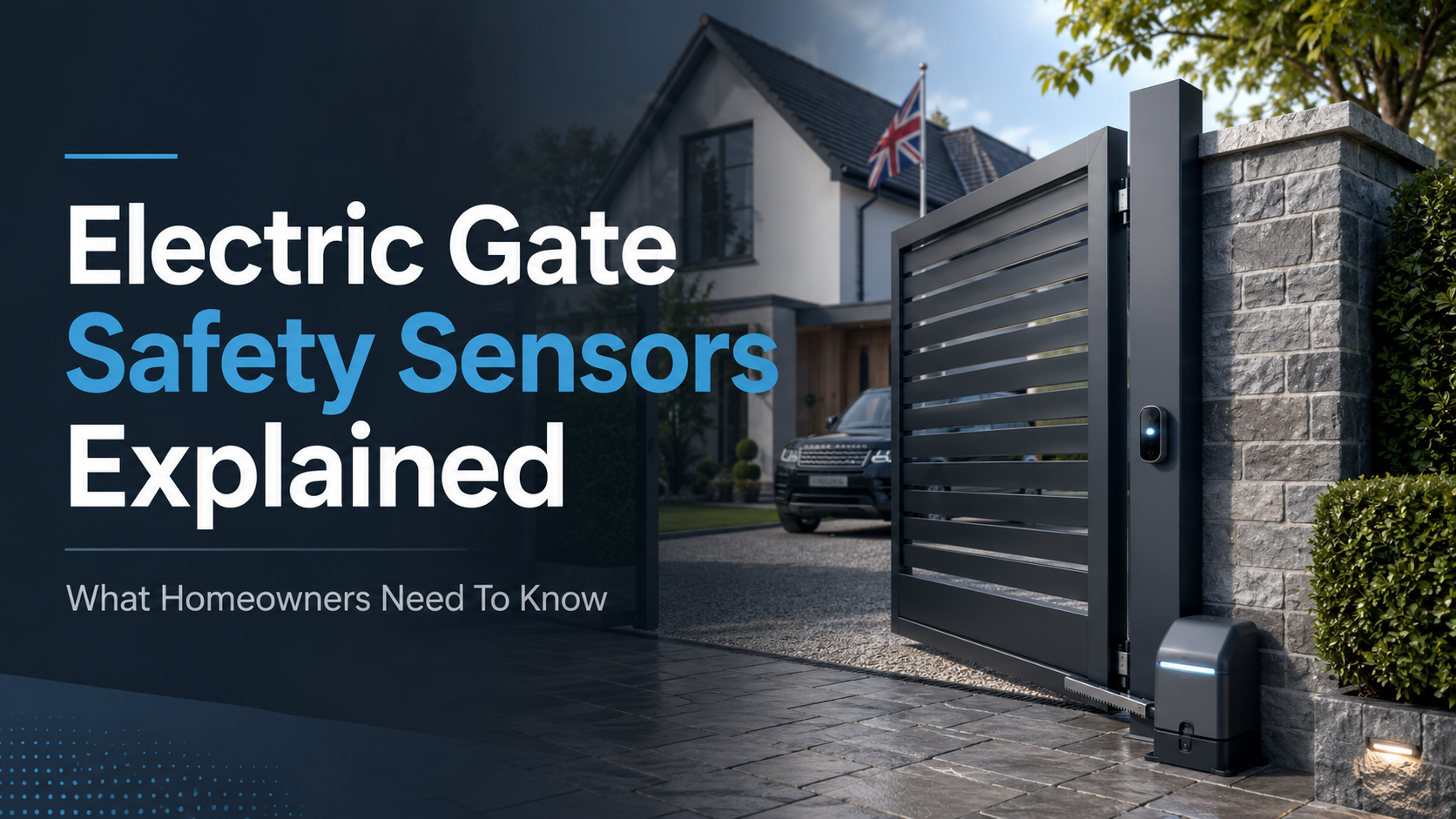
Electric gates improve security, convenience and control, but they are still heavy moving systems. Without suitable safety sensors, an automated gate can become a risk to people, pets, visitors and vehicles.
This guide explains how electric gate safety sensors work, which types are commonly used, how to spot faults and when to call a professional.
If you are planning a new installation or checking an older system, MDS Security’s automatic gates team can advise on the right safety setup for your entrance.
Quick Answer: What Do Electric Gate Safety Sensors Do?
Electric gate safety sensors detect people, vehicles or objects in and around the gate’s movement area. When a sensor detects a risk, it tells the control panel to stop, reverse or hold the gate open.
Most safe gate systems use more than one protective device. A domestic driveway gate may use photocell beams across the entrance, safety edges on crushing points and vehicle detection loops beneath the driveway. The right combination depends on the gate design, the site layout and who uses the entrance.
Why Gate Safety Sensors Matter
Powered gates must be treated as machinery. The Health and Safety Executive explains that powered gates are subject to product safety and health and safety law, and that risk assessment is vital because many powered gate installations are unique.
For homeowners, the benefits are clear: sensors help prevent injury, protect vehicles, support compliance and reduce avoidable damage to motors, hinges or tracks.
This is where the TAYA principle matters. Homeowners deserve clear answers to practical questions: are sensors required, what can fail, what maintenance is needed and what does a safe gate look like?
The Main Types Of Electric Gate Safety Sensors
Different sensors protect against different risks. A single photocell beam is rarely enough on its own, especially where children, pets, visitors or shared access are involved.
Photocell Beams
Photocells are common on domestic electric gates. They send an infrared beam between two units, usually positioned either side of the entrance. If a person, pet, vehicle or object breaks the beam, the control panel receives a signal and stops or reverses the gate.
Photocells detect an obstruction before contact happens. Dirt, cobwebs, leaves, impact damage, heavy rain and misalignment can all cause problems, so cleaning the lenses and checking alignment is a sensible first step.
Safety Edges
Safety edges are soft pressure-sensitive strips fitted to parts of the gate where crushing, shearing or impact could occur. When the edge touches an obstruction, the strip compresses and sends a signal to stop or reverse the gate.
These are important because photocells cannot protect every hazard point. Swing and sliding gates can both create crushing, shearing or trapping risks that need separate protection.
The HSE notes that additional safeguards such as pressure-sensitive strips and photoelectric sensing devices should be fitted where a risk assessment identifies a high-risk powered gate, particularly where children or members of the public may be present. See the HSE safety notice on electrically powered gates.
Vehicle Loop Detectors
Loop detectors detect vehicles using a loop of cable installed beneath the driveway surface. When a vehicle passes over the loop, the system detects the change and keeps the gate open or sends a command depending on how the system is configured.
They help prevent the gate from closing too early. Electric vehicles are usually detected in a similar way, but the installer should test the sequence with the vehicles that use the entrance.
Magnetic Vehicle Sensors
Magnetic vehicle sensors detect changes caused by a vehicle and can be useful where cutting into the driveway surface is not practical. They must be positioned carefully to reduce false triggers from nearby metalwork, cables or electrical interference.
Access Control Integration
Safety sensors often work alongside intercoms, keypads, remote controls, fobs and smartphone access. Safety must always override convenience. If a photocell or safety edge detects danger, that signal should take priority over a command to close the gate.
For related advice, see MDS Security’s guide to understanding access control systems.
Do Electric Gates Need More Than One Sensor?
Often, yes. Safe gate design is based on risk assessment, not a fixed one-size-fits-all rule. The correct setup depends on the gate type, the forces involved, the opening and closing zones, the site layout and the people likely to use the entrance.
A private driveway with controlled access may need a different setup from a shared entrance, rented property, school driveway or commercial yard. Older electric gates may also need review because safety expectations, products and guidance change over time.
If your gate was installed years ago and only has one pair of photocells, consider arranging a professional safety inspection through MDS Security’s electric gate repairs, maintenance and servicing team.
What UK Safety Standards Apply?
Powered gates in the UK must be designed, installed, maintained and used safely. BS EN 12453 is a key standard for power-operated doors and gates, covering safety in use, force limitation and test methods. The HSE also highlights duties for those who design, manufacture, install, control or maintain powered gates.
The HSE guidance on legal responsibilities for powered gates explains that installers who assemble a powered gate from component parts may become the responsible person in law, including where manual gates are converted to powered operation.
Keep installation paperwork, instructions, service records, risk assessment details and any declaration of conformity. These records help show that the gate has been maintained responsibly.
How To Check Your Gate Sensors At Home
Homeowners can carry out simple visual checks, but they should not bypass safety devices or attempt unsafe electrical work. A good routine includes:
- Clean photocell lenses with a soft cloth.
- Check that plants, bins or loose objects are not blocking the beam.
- Look for cracked cables, damaged housings or water ingress.
- Watch whether the gate opens and closes smoothly.
- Report recurring faults instead of repeatedly resetting the system.
If you are unsure how to test a safety device, follow the manufacturer’s instructions or ask a qualified gate engineer. Never bridge out, disconnect or override a photocell or safety edge to make a faulty gate work.
Common Gate Sensor Faults
The Gate Will Not Close
This often points to a blocked, dirty or misaligned photocell. Check for leaves, cobwebs, mud, condensation or anything in the beam path. If cleaning does not help, the sensor may need realignment or replacement.
The Gate Stops Halfway
Intermittent stopping can be caused by sensor faults, force settings, worn hardware or movement resistance. A gate that stops halfway should be inspected, especially if the problem is becoming more frequent.
The Gate Reopens For No Obvious Reason
False triggers can be caused by misaligned photocells, vibration, loose wiring, water ingress or vegetation moving across the beam. Make a note of the weather and timing to help an engineer diagnose the fault.
How Much Do Gate Sensor Repairs Or Upgrades Cost?
The cost depends on the gate type, the number of safety devices required, wiring condition and whether the control panel is compatible with modern equipment.
The better question is not simply “what is the cheapest fix?” It is “what will make this gate safe, reliable and compliant for the way we use it?” For wider pricing guidance, see MDS Security’s article on UK electric gate costs, installation and running costs.
When Should You Call A Professional?
You should call a professional gate engineer if the same fault keeps returning, the gate moves unexpectedly, a safety edge or photocell is damaged, the gate has no clear service history, you are converting manual gates to electric operation, or you need force testing or a safety assessment.
The HSE’s guidance on ensuring powered doors and gates are safe makes clear that anyone working on powered gates is responsible for the safety of the work they carry out and for leaving machinery in a safe condition.
FAQs About Electric Gate Safety Sensors
Are photocells enough on their own?
Not always. Photocells are useful, but they do not detect every crushing or trapping point. Many gates need safety edges and other protection depending on the risk assessment.
Can I clean electric gate sensors myself?
Yes, you can usually clean photocell lenses carefully with a soft cloth and remove obvious obstructions. Do not open electrical housings, bypass safety devices or adjust settings unless you are competent to do so.
Do older electric gates need upgrading?
They may do. Older gates can work mechanically but fail to meet modern safety expectations. A professional inspection can confirm whether sensors, edges, force limitation and documentation are suitable.
Keep Your Electric Gate Safe With MDS Security
Electric gate safety sensors are not optional extras. Photocells, safety edges, loop detectors and regular maintenance all work together to reduce the risk of injury, damage and avoidable breakdowns.
If you are unsure whether your gate is safe, compliant or due for an upgrade, speak to MDS Security. Our team can inspect your existing system, identify sensor faults and recommend practical improvements for domestic and commercial entrances.
Contact MDS Security today to arrange a site survey or discuss electric gate safety, repairs and maintenance.